Gaidhouras – Northern Cyprus Heritage (8)

gaidhouras  Gaidhouras church

The Gaidhouras church in Lefkoniko / Gecitkale is still in a good state. Until five years ago it was used as a mosque. Now the new cami is ready and the church stands empty. Pigeons have conquered the side aisle and this becomes dirty.
Locals say Greek Cypriots visit the church on a regular basis and told the church is much older than the presence of the Greeks in Northern Cyprus. I could not find any evidence about that information, no information at all actually about this church: if you have, it’s welcome!
gaidhouras     gaidhouras     gaidhouras
The inside has a completely intact floor, very beautiful and a spectacular, undamaged wooden upper-floor.
gaidhouras
Gecitkale also has a cemetery that is largely intact, although clearly neglected, unlike some other places (see my posts the coming days).
This place has been a bit away from direct fighting, and that works out better for heritage.

You may also like:
Agios Mamas church – Northern Cyprus heritage (15)
Pandeleimon – Northern Cyprus heritage (5)

Antiphonitis – Northern Cyprus Heritage (7)

antiphonitis  Antiphonitis monastery church

The Byzantine monastery church of Antiphonitis lies lonely but strategically in the hills on the north side, not far from Sourp Magar (see blog Heritage (1). It has a special and beautiful architecture. Inside it has frescoes dating from the 12th to 15th century. Part of the frescoes have been looted, but others are still there.
Greek Cypriots have heavily blamed Turkish Cypriots for the looting, even suggesting that this was part of a bigger plan of the Turkish army to make all Greek signs disappear from their point of the island. Indeed there was a proven case of a Turkish art robber, cooperating with a Dutch one (see: http://www.cyprus44.com/kyrenia/antiphonitis-church.asp. But concerning the harm done to frescoes by visitors, I found hundreds of Greek writings on unique frescoes. Many of them seem to date from before the conflicts on the island, at least the dates that people marked in (!) the frescoes are all before 1975, dates like 1910, 1929 and 1960. This suggests that the Greek Cypriots didn’t care so much or protect this heritage themselves. Just a few pictures to show the serious damage done:
     
There is nothing Turkish there…  it is too easy to blame ‘the enemy’, it is beside the facts and rather paranoid to blame the Turks for a deliberate appraoch in this destruction.

Read also these blogs:
Apostolos Andreas Monastery – Northern Cyprus heritage (21)
Maronites – Northern Cyprus Heritage (11)
Minorities in Gaziantep

Mavi Kösk Blue House – Northern Cyprus heritage (6)

mavi kösk blue house    Mavi Kösk Blue House

There are several sites describing the beauty of the Mavi Kösk Blue House between Camlibell and Sadrazam Köy. Although it is recent heritage (built in 1956) and most probably some army propaganda (see: http://www.cyprus44.com/forums/48200.asp), worth a visit everybody said. Info sites mention large opening hours so what could go wrong? But when I arrived, I was not rewarded by an entrance ticket but by learning more about car diversity.

The Mavi Kösk Blue House lies in a military camp so you pass along a soldiers barrier before approaching it. It is close to the monastery Agios Pandeleimon that I also visited. But I couldn’t pass, the guy said, because my car was a rental car from the South of Cyprus. First I thought he made a joke, but he was serious. Here I am, a Dutch person speaking quite some Turkish and visiting Northern Cyprus since many years and I was left out while others entered because I had the wrong car. Being discriminated because of your car only, I really never heard about that kind of ‘ayrimcilik’ before. Neither is it mentioned on any site about the Blue House, but the guy seriously told me ‘go change your car’, these were the rules. My offer to park the car and walk to the Mavi Kösk Blue House (only 500-1000 meters) was fiercely rejected because civilians can’t walk on a military site. Could have known that, Turks never walk anyway.

They didn’t offer me a hike to make the bridge between these few meters, they really sent me off. I think it was my first time in thirty years meeting with Turks that hospitality was denied. My experience so far was: they always find a solution, especially when you speak the language and know the culture. So they left me in shock.

It made me think of Germany some time ago. In the Netherlands, we used to drive the car we want. One could see a millionaire in a Fiat (a former Prime Minister was known for that) and a poor man in a BMW. In Germany this was not possible at that time. Every class had its car and everybody sticked with the rules and that made the world orderly and predictable. Germany changed, and so will hopefully one day the Turkish army. It is not the car that is the enemy, but the person inside it. The next spy might show up in a Turkish car….or in a car rented in the North of Cyprus. Hope Turkish soldiers will learn to see the difference 🙂

Other blogs you may like:
Elections in Turkey
A kastel is not a castle in Gaziantep
Museum of the history of Cypriot coinage
Alaniçi: moving memories of 1955 – 1974 (5)

Agios Pandeleimon – Northern Cyprus Heritage (5)

agios pandeleimon Agios Pandeleimon monastery

The monastery of Agios Pandeleimon, patron saint of physicians, in Camlibel was in closed militairy area untill recently. The church is late 16th century, the 18th century monastery was already abandoned in the ’50’s and contained little of interest. The site shows an incredible negligence. Why not clean things a bit up before you leave them open to the public, I’d say to the army; it makes a much better impression. This looks like the army has really worn out the place and when there was nothing left, withdrew from it. Even if we keep in account that the monastery was already empty for some time it is a great pity.
agios pandeleimon     agios pandeleimon      agios pandeleimon

      agios pandeleimon    

The place is extremely beautiful and could be developed for new functions although I know that the Greek Cypriot Church is fiercely against that. However, like this a precious site is just falling into pieces. Why was the army so inconsiderate with this place? I think it is the same problem as for Agios Christostomos: when a church acts like a political factor, its buildings will be treated like that too. This is how valuable heritage is lost.


On a pillar of the church I found the words: ‘sleep quiet’, obviously written by someone with Turkish background as they always write the way they speak (‘slip kwot’). Although quite some Turkish Cypriots criticize the role and influence of the army, they never deny the core function of their presence: that since the army is here, they can sleep quiet.

Read also these blogs about monasteries:
Apostolos Andreas Monastery – Northern Cyprus heritage (21)
Sourp Magar – Northern Cyprus Heritage (1)
Maronites – Northern Cyprus Heritage (11)
Antiphonitis – Northern Cyprus Heritage (7)

Agios Christostomos – Northern Cyprus Heritage (2)

agios christostomos Agios Christostomos

The church of Agios Christostomos was located in military area until 7 or 8 years ago. The Bogaz region where it stands was for many years, from 1963 to 1974 the middle point of severe fights. Most probably the status of the church was better before all this started. Looking at its exterior, there is not a big problem but when you look inside you can really see the negligence and the absolute destruction of unique frescoes:
agios christostomos    agios christostomos
Clearly for Turkish Cypriots this church is not felt as their heritage or their responsability. Agios Christostomos lies in the region where fightings among Greek and Turkish Cypriots in the ’60’s and ’70’s were most fierce. And that memory is alive, it appears, maybe also because there has always been few recognition for the problems of Turkish Cypriots. I made two other photographs here of recent graphitis:
agios christostomos   agios christostomos
The picture on the left is clear I guess, the one on the right has, if you look carefully, yellow graphiti mentioning ‘Hamitköy’. Hamitköy was the village where hundreds of refugees had to stay for over ten years in sheds and tents. They ran from Omorphita that was 80% Turkish and attacked by EOKA troops during christmas 1963. There was looting and killing and until today 150 persons are missing. It is significant that ‘Hamitköy’ is painted as a graphiti on a church.

Many Turkish Cypriots see the Greek Cypriot Church as the great inspirator of anti-Turkish feelings on the Greek side. For example at the moment Greek Cyprus has an electricity problem. Turkish Cyprus helps them out. The Greek Cypriot Government has accepted that, but the Greek Cypriot Church has heavily criticized this acceptance, as in their views anything from the North of Cyprus must be boycotted.

However unique the frescoes are, they will not be saved as long as this kind of discussions continue. Where people fight, heritage is suffering.

You may also like these blogs:
Alaniçi: 89 murders in Murataga-Sandallar (3)
Panagia Melandrina church – Northern Cyprus heritage (18)
Apostolos Andreas Monastery – Northern Cyprus heritage (21)
Graveyards as symbol of ethnic conflict

Freedom Day Northern Cyprus

Freedom Day Northern Cyprus
freedom day    freedom day    freedom day

Today I met with an old Cypriot friend. He sees his identity in the first place as Cypriot, then also as Turkish Cypriot. We saw each other in the center of Girne (Kyrenia) in the very North of Cyprus where the celebrations for the freedom of Northern Cyprus, the Turkish side of Cyprus were fully happening. 20th July 1974 the Turkish army started their action to take over charge of this part of the island, a peace operation in the eyes of some, an illegal invasion in the eyes of others. This date is now called Freedom Day.

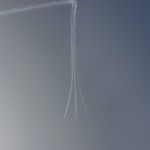
Many people came today to the harbour of Girne for Freedom Day to see the military flight show that was indeed impressive. I tried to take some photographs but the jets should have slowed down a bit for more successful pictures – you see some poor results above this blog, couldn’t do any better sorry.

Discussion was heard whether showing freedom by military force was:
1. a male expression of freedom – women would show it otherwise
2. a middle eastern way of expressing – western europe would show it otherwise
3. a way to impress and frigthen the Greeks – in this version, the jets first made a tour around the green line to make the Greeks nervous before arriving in Girne for the show
4. just fun – it was indeed a perfect and exciting show
5. a way to make the Turkish Cypriots feel safe: look how much power we have, and we protect you

My friend as well as many other Cypriots was desillusioned when there was the UN-referendum for the unification of Cyprus in 2004 and the Turkish Cypriots said yes while the Greek Cypriots said no. Strange enough the Greek Cypriots were consequently rewarded by EU membership and the Turkish Cypriots were left out. Time will show whether this was the last (spoiled) opportunity for the Greek Cypriots to restore a common Cypriot identity, above national ‘homeland’ feelings and group identities. The North of Cyprus is now developing as a more independant Turkish identity, mainlanders start to live there and bring an ‘all Turkish’ culture in – the Turkish Cypriot identity is hardly surviving in these circumstances.

When I met my friend earlier today he asked me ‘did you really come over to see this event?’. I said in a joking tune, I wouldn’t miss any opportunity to celebrate Freedom Day on Northern Cyprus. ‘Oh, I feel so free’ he said. He didn’t travel for many years because the Turkish Cypriot passport would not be recognized by any country but Turkey. The Greek Cypriot passport does not apply. And he refuses to ask for a Turkish one that indeed he can obtain and that will be recognized. His identity does not formally exist.

The Turkish army, I do believe that, has guaranteed safety for the Turkish Cypriot community here. But after 37 years they are still on this island because the necessary followup – the political and economical support for Turkish Cypriots – was never realized.  So the question is not: why are there military flight shows on a Freedom Day? But the question is: which politicians and entrepreneurs will bring better alternatives for Cyprus – when?!

Other blogs you may like to read:
Gaziantep castle: panorama and nationalism
Gaziantep war museum
Alaniçi: moving memories of 1955 – 1974 (5)