1000’s of years old boots, toys, breast pumps…


3000 years ago someone made the ‘boots’ you see here; they are rhytons, drinking vessels or horns, and date from the Urartu (read more about Urartu here). You can find them in the Medusa Glass Museum, also called the Medusa Archeological Museum in Gaziantep, Turkey. This museum is richer than most archeological museums, yet rather small in size and hidden in a back street.
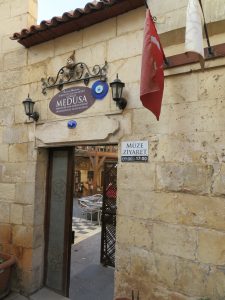
If you look around in the streets close to the Kale, the castle of Gaziantep, you can find it and most people know it so just ask around; they will show you. This museum is so much worth a visit! It is most wealthy in its collection; amazing both in the amount and the quality of its artefacts. These objects would be worth a national museum with lots of space for individual pieces. More than anything this museum shows the ‘normality’ of super ancient artefacts in this region.
If you think like me, that ‘old’ starts at least in the era BC, this museum is your place to be! Some examples: they got a range of children’s toys (‘cars’) from the early bronze age (3000-2000 BC). The picture shows 2 of them. They got lots of gold from 100 BC (Greek). While I was watching it, I looked around full of sorrow: was this place really well protected? The Medusa Museum gives you the idea of a home, rather than a museum with full security equipment… I thought (you never know).

And what about this strange object that is apparently from a very old age; it is exhibited in between a marvellous Hittite stone piece and several tablets with cuneiform writing. Alas the lack of information makes you wonder without finding the answer…
Moreover there are some figurines from 6000-5400 BC; this means among the oldest findings ever. They reminded me of findings in Malta, where the same kind of mother goddess or fertility statues were found and nobody can explain what culture they belonged to, what they mean. There is a similarity with the figurines shown in the Medusa Museum which would support the theory that in ancient times certain places served religious rituals with regard to fertility and/or the female godess.
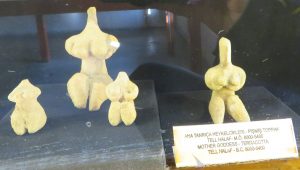
These are just some examples. The Medusa Museum is full of comparable pieces, and glass work, stone and glass jewelry that I do not show here. To finalize: there is some amazing Roman stuff (more recent, 100-200 AC):
– ‘sexual objects’ that I do not show so you have a reason to go there.
– a breast pump (really!) made out of glass. All kind of ideas came to my mind when I watched it.
For those who love ancient times and who think `ancient` goes further back than the Middle Ages, the Medusa Glass Museum in Gaziantep is a dream – you have to go there. The title `glass museum` is misleading: there are indeed many glass objects, but even more impressive is the collection of unique non-glass pieces that deserve a full presentation (it reminded me of the Archeological Museum in Amman) – more room than there is now for them.

See also: http://www.glassismore.com

Related museums in Gaziantep:
Archaeological museum Gaziantep
Zeugma museum Gaziantep


Kedi: movie about cats or humans?

kedi

The camera in the movie Kedi (Turkish for ‘cat’) follows many cats that walk in the streets of Istanbul/Turkey from the point of view these cats have of the city. This offers a great insight in their experiences. Overall in this movie, the camerawork is very special. Istanbul as a city and the inhabitants of Istanbul – especially the cat-loving inhabitants – are shown with warmth and beauty. Just the camerawork in itself makes the movie Kedi worth a visit.
But there is more to say. The core story shows us how cats conquer the people’s hearts. The cats choose who can love and feed them. And the people warmly respond to that wish. It is wonderful to see the different characters of the cats: from a clever thief to the psychopath of the neighbourhood, from the curious cat in the bag of organic tea at the market to the gentleman who never enters the place where he gets his food, but who simply scratches the window outside whenever he is hungry. The humans adapt to the cats; not the opposite. For cat lovers, watching Kedi is heaven!
And there is more to it. For those who love psychology and/or philosophy, Kedi has a lot to offer. People explain their relationships with the cats and come up with surprising remarks about what the cats mean for them: from finding money with the help of a cat to experiencing therapy by helping the cats. And what about these comments on the world:
– ‘cats absorb your redundant energy, just like earth does’
and:
– ‘cats know about God, dogs don’t. Dogs think that humans are God but cats know that humans are an instrument in the hand of God to feed them’.
Just two examples, there are many more.
One last thing I liked a lot and that made me think is a remark made about freedom. I have written about cats in Istanbul in 2012. The perspective that humans should not take cats inside to keep them there because in doing so, they will make cats forget how to be a cat, is new for me. This movie Kedi clearly shows what is meant with this perspective. Freedom is everything, even when it comes with disadvantages.
Maybe you don’t agree. Well, all I can say is: go see it yourself. There’s a lot more in Kedi then I can show here and you will not regret. Enjoy!

In Dutch cinemas from 24 August 2017
More info and a trailer at http://www.cinemadelicatessen.nl/film/kedi/

Other movies you may like:
Kurtulus son durak
Naziha’s spring (by Gülsah Dogan)

Adana archaeological museum: closed???

adana archeological museum


The Adana archaeological museum is one of the ten oldest museums in Turkey – opened already in 1924, the official government website mentions: www.adanamuze.gov.tr. You don’t need to speak Turkish to understand the unique pieces to be seen in this museum: “Neolitik, Kalkolitik, Bronz, Proto-Hitit, Hitit, Yunan, Roma, Bizans, Selçuk ve Osmanlı devirlerine ait eserlerinin yanı sıra, az miktarda Asur, Fenike ve Ermeni eseri….” But you can find some English information here: Adana_Archaeology_Museum and here, including beautiful pictures: adanaarchaelogical. Unfortunately that is all you will see as they closed this museum completely.
I was in Adana for a trademission with our ambassador and I decided to book a later return ticket the next day, because I really wanted to see this museum. I found myself in front of a locked fence. ‘I will talk myself into it’, I thought. In Turkey, most things are possible if you are kind and you speak Turkish. But the guard at the fence was different: there was no way to see even a glimpse of the beauty in this museum. ‘There were not enough visitors’, he explained and ‘it is my responsibility, I cannot do it’.
In the meantime, I am reading the book Toprak from Buket Uzuner. I bought it at the airport in Istanbul, it was in the Top 10 of Turkish books. In that book a teacher says about the Hitite city of Çorum (page 31, sorry for failures in translation, my fault): “Children, if the Hitites had lived in a western country, I guarantee you, the world’s most important archeologists and historians would work there, all the world’s tourists would stream into the city. If the people of Çorum would become master of their local history, Çorum would already have developed as an international star with trade and book fair, food and tourism festivals on world level. Be sure children that if you want it, the Hitite heritage will attract as much attention as the Egyptian pyramids, an important jewel! (…)”
Need I say more. Heritage, a matter of neglect or a matter of joy and wealth.
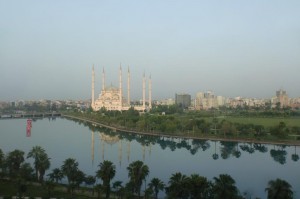
Let’s keep hope that one day the museum will open again. It is not difficult to find, if you see this spectacular new Sabancι mosque, go around the corner and you have arrived.
sabanci mosque

Other archaeological museums in Turkey’s South
Archeaological museum Gaziantep
Medusa Glass Museum

And the Archaeological museum Amman, Jordan

Street cats in Adana (Turkey)

street cat in adanaStreet cats in Adana
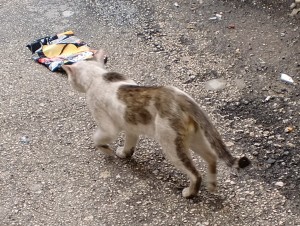
Yesterday I wrote about the street cats in Cyprus; that they are somehow loved, although the fact that they exist in such large numbers shows that the Cypriots do not deal enough with this problem: https://grethevangeffen.nl/2015/06/02/street-cats-in-cyprus/. For street cats in Adana, however, the situation is worse. It can be seen from tstreet cats in adana - kittenhe street cats’ behaviour, they are afraid. It was almost impossible to take pictures of street cats because they would run away immediately like this very small and sad kitten. It really panicked, terrible; it did not think ‘hey here is a friend that will give me some food’. The only cat I could photograph quitely was a sick cat, also quite sad: street cats in adana
If we think that animal behaviour is an expression of local values, there is quite some development work to do for street cats in Adana – they can learn from Cyprus or from Istanbul where things have developed better already for street cats: https://grethevangeffen.nl/2012/03/03/istanbul-and-its-street-cats/.
When cats are either afraid or ill, local values need reflection!

A blog about the great documentary Kedi that follows street cats in Istanbul.

Elections in Turkey

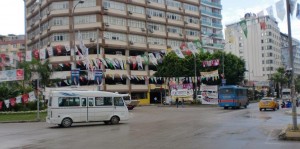
elections in turkey 0  Elections in Turkey are coming up and it is impossible to overlook them! I went to a trade mission in Adana and Mersin last week with the Dutch ambassador, his team and other entrepreneurs and we saw and heard the elections everywhere. Cars with loudspeakers shout out their messages: ‘Hey Adana’ and then the text of their campaign follows in a volume that forms an interruption for your conversation – just wait untill they passed to continue.
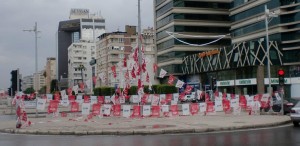
There are flags and banners everywhere, on the houses, over the street, over the river… think of a spot and the politicians did too.

Here some interesting pictures:
elections in turkey 2

CHP relatively modest on a roundabout;

elections in turkey 2

The ruling AK party: ‘Now I can go to university with my veil; they just talk, AK party acts‘;

elections in turkey 3

A big flag from the MHP party (grey wolves, a big party in Adana) and smaller – below the flag – a sign of the Saadet party: ‘not the European union but Islam union‘ (union is the same word as unity in Turkish);

elections in turkey 4

A big flag of the MHP over the road – busses and bigger cars can not go under it without touching the flag so it is damaged on the lower side but the effect is there I guess. In most countries this would be forbidden;

elections in turkey 5

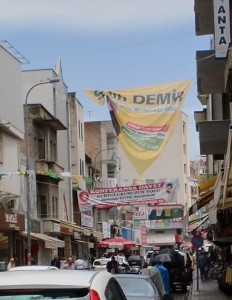
Not everybody is good in flags: the wind has frustrated the Salih Demir message here…

In the Netherlands it happens that people forget to vote. I don’t think that can happen here. Nevertheless it does not make politics more popular in Turkey than in the Netherlands; most people that I asked did not like the overall political presence.

Kurtulus son durak – Turkish film festival

Kurtulus Son Durak Poster  What a nice movie is Kurtulus son durak! Women living in neighbouring apartments in Kurtulus – Istanbul start to talk about their lives and many unexpected scenes are the result of it. Is this a feminist movie? Turkish newspapers describe it as a commercial movie about empowerment of women. But the movie was made by two men, not by women. Baris Pirhasan wrote it and his son Yusuf directed it. Baris is present at the Turkish film festival in Amsterdam and explains how the movie was created. He is a very interesting man and it is worth to ask him questions.
The movie is very funny but not without a serious tune. Also it has layers and quite some depth; what I liked a lot is the alcoholic guy who is living his own life amidst all the troubles and the adventures of the women. He even helps them at some point, but when the situation becomes very difficult with the police surrounding the appartments and all, he is watching the events happening in the apartments below him at his television. He only comes down to his neighbours in trouble when the police cuts off the electricity as a first step to enter the apartments with force. ‘The television stopped’, he explains while all the women watch his arrival in surprise, and that is just one out of many funny moments.
Baris Pirhasan explained he is using cynicism or black humour as a way to make people laugh and we did; it was a great night with a great movie that is unusual enough not to be just forgotten after the laughter. To be seen in Tuschinsky Amsterdam on Saturday 22-9, 13h and Sunday 23-9, 20.45h. Enjoy!

Other documentaries you might like to read about:
Kedi: movie about cats or humans?
Naziha’s spring (by Gülsah Dogan)
The hunt for my father (also Gülsah Dogan)
Taxi Teheran

Istanbul street cats


Istanbul street cats keep intriguing me. Changes can sometimes be perceived in small signs that function as a symbol for deeper lying norms and values I said in the blog I wrote two days ago. I found another of those small signs in the life of street cats in Istanbul.
Twenty years ago, Istanbul street cats had a very hard time. They were very thin, always looking for food and also very scared. Meeting with mankind was not something to advice to those poor cats, because they wouldn’t be treaten well. People would rather kick them or tease them than be good to them, so they carefully stayed under cars, rocks, inside empty houses and all those hiding places that only cats can find in cities. Sometimes you’d walk into one of those skinny cats that made you think: it’s not going to survive the day of tomorrow. They were sad and lonely fighting animals with a miserable city life…
This has changed a lot. Although there are still many street cats that don’t have enough food or are even ill, you don’t see them skinny and miserable the way they were in the 20th century. They are less afraid, which means that they noticed from experience that people are not such a threat for them any more and quite a few are even affectionate, asking explicitly for human attention 🙂 And they get food in many places: Istanbul citizens are putting specific catfood in safe places for cats on the street side, thus helping the poor animals out. Or they even give them some fish, like the cat on the picture in this blog. That cat also got an improvised home which is not exceptional; on many more places, people have made homes out of boxes for the street cats. Isn’t that sweet?!
If these are signs that function as a symbol for deeper lying norms and values, what are they? I think this symbolizes great progress in wealth and education in Istanbul. Istanbul twenty years ago was very much a survival of the fittest. People were striving to take care of themselves every day and a large part of the street population was uneducated. Hundreds of thousands of people moved from the provinces to the big city of Istanbul hoping to find a better life and the city had problems to embrace them all. Street cats, harmless and defenseless, were on the lowest spot of the ladder and paid the price.
Nowadays, it is clair that the people in Istanbul have time and energy left to take care of animals like the streetcats. Being valued as a human means that one can value an animal as an animal and embrace animals in their very existence close to mankind. Once the concurrency for food and survival is gone, care can be deployed. The conclusion is that Istanbul as a whole goes better because the Istanbul street cats go better!

Other blogs about this theme:
Street cats in Adana
Streets cats in Cyprus
Kedi: movie about cats or humans?

Other blogs about Istanbul:
Istanbul: mysterious tickets
Istanbul: no regret for my changed decision

Istanbul: mysterious tickets after Süleymaniye Mosque donation


Süleymaniye Mosque

On leaving the beautiful Süleymaniye Mosque (also known as the Blue Mosque) I gave a donation to a guy sitting at the exit of the Mosque with a sign ‘donations for the Mosque’. As the entrance was free and usually the maintenance of this kind of buildings is enormous in costs, it seemed reasonable to have some contribution. I gave money and got a few blue tickets in return for that. I looked at them and thought, why do I get this kind of tickets? I gave a donation, but what is this for?
As my brains couldn’t find a solution, I started to think the Dutch way. This must be a proof for tax administration that a donation was made, I thought. In the Netherlands this exists; for income that is spent in gifts to good aims, citizens don’t need to pay taxes. But you must be able to proof that you gave away that money. I suggested the Turks might have the same system and that the tickets I got at the Süleymaniye Mosque served to prove to Turkish taxes that this money was really spent as a gift. But I also know that perspectives can be coloured too much by national perspective. The reason why I got the tickets could be completely different.
So in the restaurant, close to Süleymaniye, where we had dinner after visiting the Mosque, I showed my newly acquired tickets to the staff and asked them for the meaning of them. The staff was very surprised about it: ‘we have never seen these tickets before’. They started to question me ‘the Mosque is free to visit, why did you give them money?’.  I tried to explain to them the idea, or should I say idealism, of donations but my table company destroyed it all by saying ‘she wanted to feel good about herself’, making everybody burst out in laughter as if I were the kind of fool that was hardly seen in this part of Istanbul.
The restaurant staff explained to me ‘the government takes care of the Mosque, they don’t need your money’. Hey, I don’t give up that easily so I responded in an utmost surprised way ‘ah, I thought Turkey has a separation of state and religion’. ‘Well yes’, they replied, ‘the state doesn’t pay any money but local government does, the city of Istanbul is taking care of the Mosque’. I thought that the separation of state and religion also involved local government as well as national government but they thought that local was completely different from national and showed surprise that the City of Amsterdam is not giving money to churches or mosques ‘Istanbul is very social but Amsterdam is not’.
Soon enough, we started to talk Turkish instead of English and we jumped from the way Christians were treated in the South-East of Turkey to the way Muslems were treated in Greece and Bulgaria. I got a bit upset and so did they, and they had the superiority of language, meaningful in situations like the moment where I said that the monasteries in the North (güney) had a hard time under Turkish government when they declared there were no monasteries in the North – like I usually do, I mixed the words South and North (kuzey versus güney); a problem of mastering a language that weakened my arguments because they wouldn’t notice that I was not telling an ‘untruth’ but making a language mistake.
We didn’t really find a solution for Muslems in Greece and Bulgaria or for Christians in South East Turkey but we had a drink together to close the discussion. The only problem that lasts now is that my question about the tickets was left unanswered: why does a tourist who gives a donation to the Süleymaniye Mosque get tickets showing the period, the amount and the purpose of the donation? If you, reader, know the answer, please send me a message because I really like to know after all…

Other blogs you might like:
Istanbul and souvenirs with a religious component
Agios Nikolaos
Istanbul street cats

Istanbul religious souvenirs

Istanbul religious souvenirs

Changes can sometimes be perceived in small signs that function as a symbol for deeper lying norms and values. One of those signs in Istanbul is the way souvenir shops deal with presents that have a religious component. When I was here twenty years ago, the presents with different religious background were thoroughly separated from each other. For example in the jewelry market, jewelry with the ‘bismallah’ sign were sold in shops with a muslem owner, golden crosses were sold in shops with a christian owner. In that time there was no mixed collection of presents with religious component to be found at the same shop; absolutely nowhere!
This is something that has really changed now. In many shops it is possible to find articles with islamic, christian and jewish meaning all together not just in the same shop, but also on the same shelve. For someone like me who missed 20 years of Istanbul development, it feels like a radical change. I asked some questions about it in one souvenir shop and the workers there kindly explained to me that they believe in and respect all the prophets. I tried to explain them how this was in the years ’70, ’80, even begin ’90 but they kept telling me how they feel about it now. They couldn’t explain history to me, why it was different before and why it changed. They had Maria and Jesus hanging in their shop next to islamic holy artefacts, see the picture above, and considered that as normal.
I cannot analyze this yet, it would need a more indept insight but as said I have seen this mixture in many shops in Istanbul city already. These are small signs for what could be a more fundamental change. My first and overall impression is that the selfconfidence of the Turks has increased a lot in daily life, and tolerance often comes with selfconfidence. Another way of looking at it could be that the Christian minorities form no more threat whatsoever to the Turks which allows a different attitude. Finally, it is also possible to look at this businesswise. The Turks were always good in customer service, eager to help customers out, create strong relationships and earn some money; maybe they have just added these new products to their buckets…

Other interesting blogs:
Minorities in Gaziantep
Istanbul: mysterious tickets
Mikve Israel-Immanuel synagogue
Ramallah: Jews removing Christians from Middle East

Istanbul: no regret for my changed decision

My last visit to Istanbul was over 20 years ago. Did it change?, I thought when I booked for my fifth trip to Istanbul. 20 years is a lot!

My first trip to Istanbul was short after the third coup in the early eighties. I was a student for the first time in a country where the army played a big role and looking back I think I was partly unaware. There was a soldier on every corner of the road in Istanbul and there were hardly any tourists. It was a strange time and as a student, I was very excited, curious, eager to learn more about the world.
In 1990 or 1991 after quite some travelling in Turkey during the years, I decided that I was at last really fed up with the behaviour of Turkish men who wouldn’t let western women any freedom; I will never go again, I said, and focussed since then on Turkish Cyprus as one of my favorite places to be.
However, not every decision can last for a life time and now I am back, enjoying to be back really! By now I have walked around Istanbul all day in snow and wind and I found it both familiar and renewed. Familiar is the way of life, the simits and marrons and lots of other stuff one can buy in the streets, the friendliness of the people, the silent and thankful smiles when a tourist appears to speak some Turkish. Renewed is the pavement of the roads, the electricity that I remember, at that time, had open cables everywhere, quite dangerous in a busy city. The city is definitely a lot richer, the pavement of streets has been taken care of and the garbage in this intensely lived city is now none compared to my memories of the 20st century. Religion is more present in daily life than it was before, but women seem to be more free in the meantime.
A city that has existed for so many ages wouldn’t radically change: it keeps it character but it develops, that is my conclusion. And it is nice and beautiful as ever!

Other blogs you might like:
Freedom day Northern Cyprus
Istanbul street cats
Istanbul religious souvenirs

Freedom Day Northern Cyprus

Freedom Day Northern Cyprus

freedom day    freedom day    freedom day

Today I met with an old Cypriot friend. He sees his identity in the first place as Cypriot, then also as Turkish Cypriot. We saw each other in the center of Girne (Kyrenia) in the very North of Cyprus where the celebrations for the freedom of Northern Cyprus, the Turkish side of Cyprus were fully happening. 20th July 1974 the Turkish army started their action to take over charge of this part of the island, a peace operation in the eyes of some, an illegal invasion in the eyes of others. This date is now called Freedom Day.

Many people came today to the harbour of Girne for Freedom Day to see the military flight show that was indeed impressive. I tried to take some photographs but the jets should have slowed down a bit for more successful pictures – you see some poor results above this blog, couldn’t do any better sorry.

Discussion was heard whether showing freedom by military force was:
1. a male expression of freedom – women would show it otherwise
2. a middle eastern way of expressing – western europe would show it otherwise
3. a way to impress and frigthen the Greeks – in this version, the jets first made a tour around the green line to make the Greeks nervous before arriving in Girne for the show
4. just fun – it was indeed a perfect and exciting show
5. a way to make the Turkish Cypriots feel safe: look how much power we have, and we protect you

My friend as well as many other Cypriots was desillusioned when there was the UN-referendum for the unification of Cyprus in 2004 and the Turkish Cypriots said yes while the Greek Cypriots said no. Strange enough the Greek Cypriots were consequently rewarded by EU membership and the Turkish Cypriots were left out. Time will show whether this was the last (spoiled) opportunity for the Greek Cypriots to restore a common Cypriot identity, above national ‘homeland’ feelings and group identities. The North of Cyprus is now developing as a more independant Turkish identity, mainlanders start to live there and bring an ‘all Turkish’ culture in – the Turkish Cypriot identity is hardly surviving in these circumstances.

When I met my friend earlier today he asked me ‘did you really come over to see this event?’. I said in a joking tune, I wouldn’t miss any opportunity to celebrate Freedom Day on Northern Cyprus. ‘Oh, I feel so free’ he said. He didn’t travel for many years because the Turkish Cypriot passport would not be recognized by any country but Turkey. The Greek Cypriot passport does not apply. And he refuses to ask for a Turkish one that indeed he can obtain and that will be recognized. His identity does not formally exist.

The Turkish army, I do believe that, has guaranteed safety for the Turkish Cypriot community here. But after 37 years they are still on this island because the necessary followup – the political and economical support for Turkish Cypriots – was never realized.  So the question is not: why are there military flight shows on a Freedom Day? But the question is: which politicians and entrepreneurs will bring better alternatives for Cyprus – when?!

Other blogs you may like to read:
Gaziantep castle: panorama and nationalism
Gaziantep war museum
Alaniçi: moving memories of 1955 – 1974 (5)