

Balıklıgöl in Şanlıurfa is like a place deriving from the stories of 1001 night… or like one of the best places we have in the Netherlands, the Efteling. Balıklıgöl means fish pond and it contains more carps than you have seen or will ever see again in your life. Equally interesting is the story of the sacred fish pond’s origin. Balıklıgöl is not just very beautiful, it is also very holy part of the Dergah Komplex around Abraham’s cave of birth.
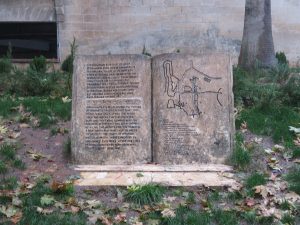
Once upon a time there was the cruel King Nimrod and the first monotheist in ancient times Abraham. King Nimrod had not succeeded to kill Abraham as a baby because his mother had given birth in a cave and hidden her child there during many years. So now King Nimrod, a worshipper of idle gods, had to cope with Abraham who resisted against existing religious practices. There is only one God, Abraham claimed and indeed he was pushing to have his point taken. King Nimrod got very annoyed with that man and decided to throw him into the fire to get rid of him once and for all. But Abraham had God on his side! God changed the fire into water for Abraham to make a soft landing and God changed the pieces of wood into carps. This is how Balıklıgöl – the sacred fish pond was created and Abraham survived to fulfill his precious work of the introduction of monotheism. Rumors say by the way that this is a story with roots in Jewish scriptures rather than Islamic scriptures but conservative Şanlıurfa is not the best place to discuss this sensitive type of rumors so I didn’t. Feel free to comment below if you have good knowledge about this, though.
Today Balıklıgöl is a favorite place to go for people of all ages. They feed the carps who will show up with hundreds – no exaggeration! – and squirm up, over, under each other to pick up the food thrown in the water. You can buy special food for 1 lira from sellers in boots next to the pond. And always remember this is a holy pond: if you try to eat one of the carps, you will become blind.
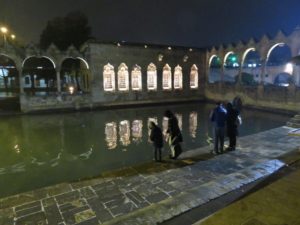
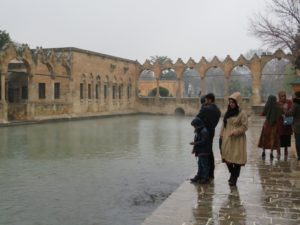
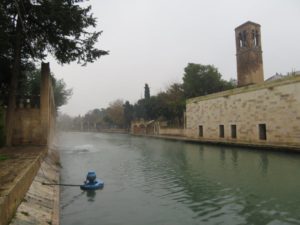
On the west side of the pond is the Halilur Rahman Mosque, another mosque that was built on a former church, a fact supposed to symbolize perceived holiness since many ages. The Halilur Rahman Mosque dates from early 13th century but the minaret, squarish in shape, is said to date originally from the church. I did not see the inside because it was closed for restauration purposes when I visited (Dec.2018).

On the north side is the 18th century Rızvaniye Vakfı Mosque and Medrese complex, open to all visitors.

On the south side is a great parc with trees, very green grass to my surprise (because of exceptional rainfall), restaurants and several canals used to bring up the young carps as you can see in the picture below: the young ones are also countless…
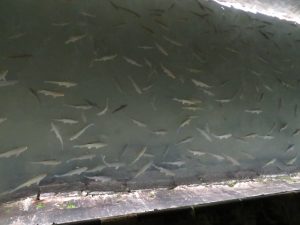

The parc ends where the rocks of the castle, the Kale, begin. To the east is Abraham’s cave of birth and the Mevlid-i Halil Mosque and beyond that the grand bazaar. But I’d say that the Balıklıgöl is worth a visit just by itself. It is wonderful to see both in daytime and in the evening!
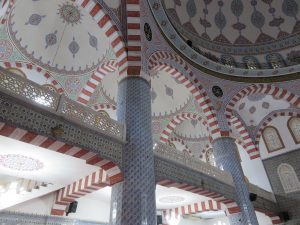


 And we went into the oldest kastel, Pisirici Mescidi ve Kasteli from the 13th century. It looked very beautiful, well taken care of. In the different ‘niches’ you see on the picture above are toilets and baths where people could wash themselves. The water is very clean and also cold; it is not like a Roman bath where heating systems were in place. The roof was made so that good airconditioning for the kastel was secured, both in cold and in warm seasons, to have some kind of pleasant ‘average’ temperature continuously.
 On the other side of the water reservoir room, there is a mescid, a room for prayer. They were often combined with the underground water reservoirs because it enabled believers to have their rituals in washing according to the islam
 ic rules. Book shelves formed a small library in the mescid. Thus multifunctional centers existed already at very early stages in Gaziantep. Kastels are not very large and they won’t take a lot of your time when you visit them. But they are worth your visit as they are unique and refined in shape and light.
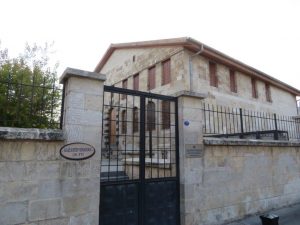 Few signs indicate that Gaziantep once had thriving minority communities who largely contributed to the wealth of the city in trade, science and arts. The former synagogue has been restaured and is now a cultural center for the university.
  The former Kenderli church has also been transformed into a culturel center. The former Armenian Catholic Surp Asdvazdadzin church is now a mosque called the Liberation Mosque (Kurtulus Camii).
  In the center close to the castle there is a neighbourhood called Bey where the minorities used to live. It is full of cafes and hotels and also home to quite some Syrian refugees. The investment in restauration is strikingly less here than in other parts of the city. What is rebuilt, is the great Ottoman past. There is an inclination to wipe out a part of history that is more difficult to explain.
 Craftmanship
 In front of Emir Musa’s shop, you find Ramazan’s Sahlep Car. Sahlep is a milk drink on the basis of an orchid root. It is very hea
 lthy and helps you through winter times (in summer he must be selling some other drink). Ramazan serves his sahlep with cinnamon and pistaccio and it is the best sahlep I ever drank in Turkey.
 While walking or travelling through Gaziantep, you will find a city that is clean and well taken care off, with good public transport. The city is old (= oneven in surface) but on several places there are efforts to make it accessible also for people with a handicap. The Zeugma Museum houses an organisation for young people with a handicap. There are visible efforts for all to participate (except minorities from other religions, see a later post). Works are ongoing everywhere. Gaziantep is the 6th city of Turkey and the 3rd in wealth. The government invests actively in the development of the city: building and restauration, tourist attractions, parcs, trade, transport.
  As for restauration, especially remains of the Osman period get government attention as well as anything related to the War of Independance or remains from pre-islamic, ancient times. In an old Osman neighbourhood I had a guide who showed me around for a few hours and refused to accept any money as the government paid him for his job. This guide was well educated, he knew everything about his part of the city, also historical. His expertise, enthusiasm and honesty were impressive.
 Walking and sports
 To be honest, in the way it was organised it looked a bit chaotic – on certain crosspoints many took different directions – but it was a real sportive challenge and fun in the meantime. A great event that got the right attention.
 Last but not least, there are only few visitors from abroad in Gaziantep, all tourists are Turkish. I myself got several warnings beforehand not to go to Gaziantep that would be dangerous because of the Syrian border nearby and because of the political situation between Turkey versus the Netherlands and Germany: the Turks might arrest me. Except from normal security matters there are no specific dangers in Gaziantep, on the contrary: the great hospitality in Gaziantep means that all want to help you for whatever you need. There has not been one single prejudice about me being Dutch and the political blabla. I do not consider Gaziantep more or less dangerous than Istanbul, Izmir, Paris or Rome. Don’t let nervous comments prevent you from visiting Gaziantep!
 The city is big, two million inhabitants, but has the character of a provincial city. That means that many people only speak Turkish and their knowledge comes from Turkish speaking media which is, compared to international cities, limited. The struggle for daily life is predominant, global issues such as sustainability are rather unknown. Refusing a plastic bag in a shop ‘because you already have a bag’, to save the environment, is not understood, it is not within their frame of reference. Shop keepers will feel that you do not let them take good care of you and get disappointed. This is a gap you might not bridge during a simple visit. I just took the plastic bags and stayed friends with the locals. As for the language, try to learn a few words, it will be highly appreciated. Be aware when you try to explain something, that people with no experience in second language learning usually do not understand your problems such as `looking for words’. If they don’t help you in expressing yourself, that is the reason. Use objects to show what you want and see the humour of the struggle. Gaziantep locals have a great sense of humour and creativity. As long as respect is shown, all problems will be solved.


 Karkemish is on the border with Syria; half of the ancient city (antik kent) lies in Syria (Jarablus). I wanted to visit this but it is still closed due to the situation in Syria. Still there are active excavations and the Turkish government is preparing to reopen Karkemish as soon as possible.


 (be aware: all signs here are in Turkish only – either you can explain the animals to your children yourself or bring a dictionary) and it is fun to walk around.


 Other ‘puppets’ make clear how women and even children were filling the bullets.
 made quite explicit in several puppets. The picture here shows the underground hospital and you can see the blood run.
 Most of all however, I liked the rattles. When the French started to shoot and the Turks didn’t have enough ammunition, they would play the rattles to imitate gunfire. I got a demonstration from my guard, it was brilliant – you’d really think that a well equiped army is responding to your gunfire…

 It is nice and well enough restaured for a good impression what the castle was like in the old days.
 Lots of kids are visiting the castle to learn about the war but also many Turks from Gaziantep and elsewhere show indepth interest in the exposition.
 More on this subject:
 Also they have touchscreens where you can look up the mosaic you prefer and watch it in detail; or another touchscreen where they show you ‘land’ and you have to guess which mosaic lies under the ground. The only thing lacking is the translation of Greek texts: some mosaics show texts and you’d like to know what they say. You’d expect a museum to explain that to its visitors…
 1. The Gypsy Girl, who has somehow become the symbol of Gaziantep; she is everywhere in the streets, in shops, on the airport. They gave here a special place in a dark room where no one enters without the presence of a museum guard. And there she is, in the dark, brilliant and mysterious in the same time, uniquer than unique among all the mosaics. Indeed it is a masterpiece. While I was standing there alone in the dark, she seemed to look right through me…
 2. The Galateia mosaic, seen from above. Some mosaics have more worked out details or fuller images. I liked this one because of the balance and the colours. A description of the Galateia story can be found on the website of the museum (in English and Turkish, if you like),
  3.The out-of-the-box mosaic. I haven’t got a clue what it is but I adored it immediately. It is one of the more recent mosaics. Apparently, in that period, they started to put images in the mosaics just where they wanted – at random – no apparent rules were followed any more. I imagine that it was a breakout from all the detailed work that was done during ages; and how free it felt and how it was criticized by traditionalists and knowledgeable people and all those who feared that craftmanship was now about to disappear, to be replaced by art work that ‘even my three year old son can make’.