The Archaeological Museum Gaziantep has a large and most interesting collection, starting with fossiles and ending with islamic artefacts from the Osmanli period. The start of the museum shows all the periods of Gaziantep history and their timelines; with the last period, the Turkish Republic, as the greatest. The Archaeological Museum Gaziantep is well designed and well organized. The objects are presented beautifully and all signs are in Turkish and English.
The collection is overwhelming in variety and quality. If you go to a Western Archaeological Museum, most of the collection derives – legally or illegally – from other countries. Not here…. Gaziantep is one of those places where civilization started at a very early age. The collection derives not even from ‘Turkey’ as a whole but from the region. Locals told me that they grew up with archeological artefacts; just by playing outside, they would regularly find old stuff. It is everywhere. So nobody will tell you about the beauty of the museum: locals consider this richness as a normal status!
You can easily spend two hours at the museum. If you can only endure one hour at most (like many people do), chose your period in advance and go to the part of the museum where that can be found.
Choice of masterpieces
I give you here some pieces that I found very interesting – remember that it is a choice out of thousands of artefacts so go and see for yourself what you like.

Neolithic prehistory: it is always nice to find a lively scene at the entry of a museum. Many evidence of early settlers (10.000 – 5.500BC) were found in the Gaziantep region.

A grave that dates from the Iron Age, with gifts that indicate a belief in life after death. The necropolis at the Euphrates in Nizip showed that graves were reused multiple times throughout the years. ‘Old’ bones and their ornaments were just pushed aside to make room for the newcomer.

Kuttamuwa Stele, used in a temple where sacrifices were brought for the death. There is a video in the museum that revives the temple and the ceremonies, very nice!

Steles from the Hittites. Depicted is Teshup, the God of the Mountain, of Trade etc. Wonderful pieces!

Banquet Staged Stele, also Hittite period: if you see this 2800 year old picture, you can imagine that you would have a nice night out dining with a Hittite friend. There is no time-gap in pleasure…
 Karkemish is on the border with Syria; half of the ancient city (antik kent) lies in Syria (Jarablus). I wanted to visit this but it is still closed due to the situation in Syria. Still there are active excavations and the Turkish government is preparing to reopen Karkemish as soon as possible.

The pieces are absolutely unique. For several objects, there are texts on the back side in hieroglyphs or cuneiform (both were used) and they are translated in Turkish and English on signs: extremely interesting.

Red polished ceramics of the Urartu; perfection of craftmanship and the ability to organize trade for it 2800 years ago. Design used not just by royals, also by ordinary folks. Just wow.

Urartu bracelets, have a look: the same type of bracelets can even be sold today. They have designed jewelry that passed through the ages…

Roman bracelets, made out of glass. They are so beautiful! I’d love to see those reproduced in the actual days (maybe an idea for the Murano factories in Italy?).
Notice: I skipped fossiles, beautiful iron objects, dramatic Urartu weapens, Persian statues, Commagene objects, golden jewelry… it is just too much to show here. So: go there and see for yourself.
How to get there?
Be aware that there are 3 museums in Gaziantep about antiquities. This is information that is hard to find on internet and locals generally do not know the exact details.
* Medusa Glass museum with glass and many ancient artefacts, this is a private museum next to the Castle/Kale in the center.
* Zeugma Museum for mosaics, seen from the center it lies on ‘the other/outer side’ of the former train station, a 2-3 kilometers walk from the Castle/Kale.
* Archaeological Museum, next to the Stadion (locals know the Stadion best so ask for that location). Organisationally Zeugma and Archaeological Museum belong together, in distance there is about 1,5 kilometer between them, both on another side of the former train station. Archaelogical Museum Gaziantep is about 1-1,5 kilometer walk from the Castle/Kale.
Museum shop
Both the Archaeological and Zeugma Museum have a beautiful museum shop with original products, prints of museum artefacts on magnets, booklets, cushions etc, handwoven high quality shawls or handmade bags and so on. The books they have about archaeology, economy, trade and local life are most interesting but alas only in Turkish. The cooking book of the Gaziantep kitchen would deserve a translation in the first place as this excellent kitchen is attractive for many nationalities, not just Turks. Note that the shop in the Archaeological Museum Gaziantep is at the entrance but they lead you out through the cafe, so for the shop you have to walk back to the entrance to find it; in Zeugma museum shop and cafe are combined at the exit (and they have good coffee 🙂
More info also at: http://www.gaziantepkulturturizm.gov.tr/EN-200731/gaziantep-museum-of-archaelogy.html
You may also like this blog: Archaeological Museum Haarlem


 And we went into the oldest kastel, Pisirici Mescidi ve Kasteli from the 13th century. It looked very beautiful, well taken care of. In the different ‘niches’ you see on the picture above are toilets and baths where people could wash themselves. The water is very clean and also cold; it is not like a Roman bath where heating systems were in place. The roof was made so that good airconditioning for the kastel was secured, both in cold and in warm seasons, to have some kind of pleasant ‘average’ temperature continuously.
 On the other side of the water reservoir room, there is a mescid, a room for prayer. They were often combined with the underground water reservoirs because it enabled believers to have their rituals in washing according to the islam
 ic rules. Book shelves formed a small library in the mescid. Thus multifunctional centers existed already at very early stages in Gaziantep. Kastels are not very large and they won’t take a lot of your time when you visit them. But they are worth your visit as they are unique and refined in shape and light.
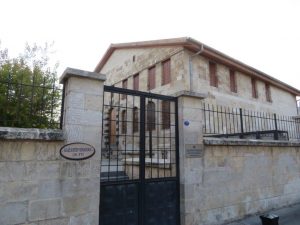 Few signs indicate that Gaziantep once had thriving minority communities who largely contributed to the wealth of the city in trade, science and arts. The former synagogue has been restaured and is now a cultural center for the university.
  The former Kenderli church has also been transformed into a culturel center. The former Armenian Catholic Surp Asdvazdadzin church is now a mosque called the Liberation Mosque (Kurtulus Camii).
  In the center close to the castle there is a neighbourhood called Bey where the minorities used to live. It is full of cafes and hotels and also home to quite some Syrian refugees. The investment in restauration is strikingly less here than in other parts of the city. What is rebuilt, is the great Ottoman past. There is an inclination to wipe out a part of history that is more difficult to explain.


 (be aware: all signs here are in Turkish only – either you can explain the animals to your children yourself or bring a dictionary) and it is fun to walk around.


 Other ‘puppets’ make clear how women and even children were filling the bullets.
 made quite explicit in several puppets. The picture here shows the underground hospital and you can see the blood run.
 Most of all however, I liked the rattles. When the French started to shoot and the Turks didn’t have enough ammunition, they would play the rattles to imitate gunfire. I got a demonstration from my guard, it was brilliant – you’d really think that a well equiped army is responding to your gunfire…

 It is nice and well enough restaured for a good impression what the castle was like in the old days.
 Lots of kids are visiting the castle to learn about the war but also many Turks from Gaziantep and elsewhere show indepth interest in the exposition.
 More on this subject:
 Also they have touchscreens where you can look up the mosaic you prefer and watch it in detail; or another touchscreen where they show you ‘land’ and you have to guess which mosaic lies under the ground. The only thing lacking is the translation of Greek texts: some mosaics show texts and you’d like to know what they say. You’d expect a museum to explain that to its visitors…
 1. The Gypsy Girl, who has somehow become the symbol of Gaziantep; she is everywhere in the streets, in shops, on the airport. They gave here a special place in a dark room where no one enters without the presence of a museum guard. And there she is, in the dark, brilliant and mysterious in the same time, uniquer than unique among all the mosaics. Indeed it is a masterpiece. While I was standing there alone in the dark, she seemed to look right through me…
 2. The Galateia mosaic, seen from above. Some mosaics have more worked out details or fuller images. I liked this one because of the balance and the colours. A description of the Galateia story can be found on the website of the museum (in English and Turkish, if you like),
  3.The out-of-the-box mosaic. I haven’t got a clue what it is but I adored it immediately. It is one of the more recent mosaics. Apparently, in that period, they started to put images in the mosaics just where they wanted – at random – no apparent rules were followed any more. I imagine that it was a breakout from all the detailed work that was done during ages; and how free it felt and how it was criticized by traditionalists and knowledgeable people and all those who feared that craftmanship was now about to disappear, to be replaced by art work that ‘even my three year old son can make’.
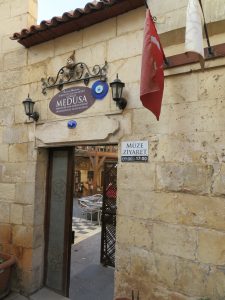 yet rather small in size and hidden in a back street.
 If you think like me, that ‘old’ starts at least in the era BC, this museum is your place to be! Some examples: they got a range of children’s toys (‘cars’) from the early bronze age (3000-2000 BC). The picture shows 2 of them. They got lots of gold from 100 BC
  (Greek). While I was watching it, I looked around full of sorrow: was this place really well protected? The Medusa Museum gives you the idea of a home, rather than a museum with full security equipment… I thought (you never know).
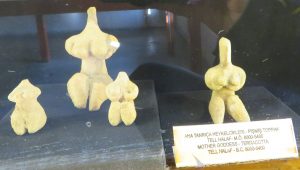 They reminded me of findings in Malta, where the same kind of mother goddess or fertility statues were found and nobody can explain what culture they belonged to, what they mean. There is a similarity with the figurines shown in the Medusa Museum which would support the theory that in ancient times certain places served religious rituals with regard to fertility and/or the female godess.
 e. To finalize: there is some amazing Roman stuff (more recent, 100-200 AC):
 Compared to my childhood visit many elements were added in the ‘museum’; quotes on walls or on blinded windows – short video’s from witnesses, classmates of Anne and the like. They are very impressive.
 I really thank the Anne Frank House for this opportunity. I wonder why this does not become more usual in Amsterdam. As for me, it is not about the free ticket, but the fact that I could go at 21.00h (I came home from work only at 19.30 and had to have dinner first) and that I did not need to wait in a queue or go in with plenty of loud speaking tourists. Would it be financially difficult for musea to have similar evening offers or are they just not used to opening hours in the evening?