

After the visit of the 3 churches in Alaniçi I went to a coffeeshop in the middle of the village to find out more about the background of the extensive graffiti on those churches, mentioning EOKA, ENOSIS and more signs of a cruel past and ethnic cleansing in Cyprus. It was easy to get in contact with some elderly locals. They explained that they originated from villages in the Larnaka region, now in Southern Cyprus. When the Turks came to the rescue of the Turkish Cypriots in 1974, many Greek Cypriots flew to the south while Turkish Cypriots flew to the north.
 It was a traumatic event where many inhabitants from both sides had to leave not just their possessions but also the neighbourhoods and the lands they deeply loved. Greek Cypriots have been mourning loud and clear ever since, asking back their belongings and the lands of their ancestors. The Turkish Cypriots have been mourning too, about a lost past. As their safety was at stake in the period of the conflict, they had no interest to go back to where they came from after 1974. They helt no political lobby and just mourned in silence. See also my blog about different perspectives on heritage between the north and the south.
Alaniçi (Peristerona Pigi) was originally a mixed village, with Cypriots of Greek and Turkish background. But already long before 1974, no more Turkish Cypriots lived in this village, an old man told me. They went to neighbourhoods further in the fields because they were threatened. Ethnic cleansing had an early history here (later I found confirmation of that story on this website). In 1974 the Greek Cypriots left Alaniçi for the south while Turkish Cypriots coming from the south were rehoused in empty Greek villages.
 When I asked about the graffiti of EOKA on the churches, the locals became emotional and did not want to talk any more about this subject. It was only then that I realized that the places of the 1974 massmurders were here; I always thought they were close to Lefkosa (Nicosia) and had been looking without ever finding them.
  The locals were happy to show me the road to those villages: Murataga, Sandallar and Atlilar; I think they were just happy that going there meant I would leave them alone. There was no anger or bitterness in their avoidance: just an immense grief. They would not express that in words. It was like a cloud that had covered them – and me, by the way.
 The road went through fields where there seemed to be absolutely nothing. And then, suddenly, it was there. A monument, a graveyard that looked quite new, a short photo exhibition, a sign pointing at the location of a mass grave. It is difficult to imagine that there can be so much hatred in the wideness and largeness of empty fields… but it had been there. I stepped out of the car to take a closer look into the cruel past of Cyprus (to be continued in the next blog).


Alaniçi: ethnic cleansing was early history here (2)
Reply

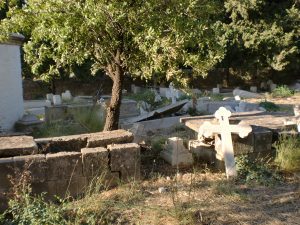 (the Turkish side), the Greek graveyards may have been destroyed deliberately as they are all in a devastating state. The situation for Turkish cemetaries in the South of Cyprus (the Greek side) is different, he says. This raises questions about why this is the case and M. Thorsten Kruse comes – roughly – to conclusions as I formulated in
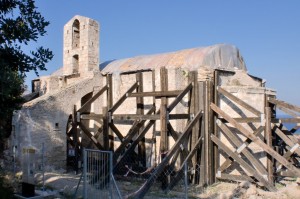

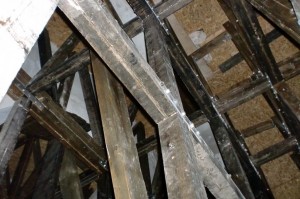


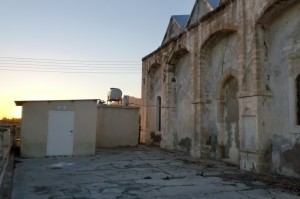

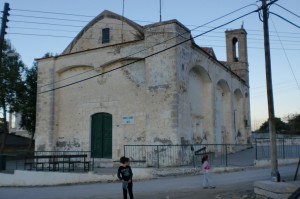
 as the picture here shows. The clock itself is still there but seems to have fallen down and rest on the wall sides.

 In
In 


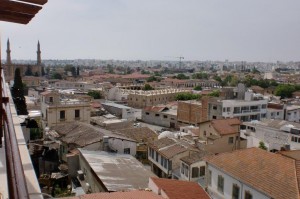
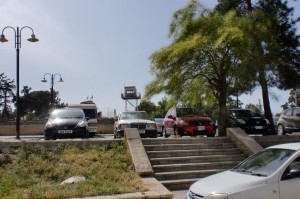 Invisible here, inbetween the two city parts lies the Green Line, a 100 meter large strip where the UN rules since 40 years (!) to separate the Greek Cypriots from the Turkish Cypriots… Easy to understand how bored the UN-soldiers are here, they just ride around in expensive UN-cars as there is nothing else to do. The fighting has stopped long ago and the frontier is even ‘open’ since 2003 at three points at the Green Line Nicosia. Parties make small steps forward that symbolize progress like the abolishment of giving stamps every time a person crosses the transit point; this step was the first result of the new peace negotiations that started 2 weeks ago. It lead to quite some confusion especially at the Turkish side: the protocol had to change but Turkish officials love stamps – clearly that was really a thing to give up for them 🙂 Anyway the international community was investing here at least 30 years in vain, paying for useless UN-presence, boycoting the North / Turkish side without any result. For how long will we continue to do so? And why?
 i
i cosia could be a beautiful and flourishing city but it is not because it has no heart but a Green Line, a real wall in the middle of it: see the pictures, where we walk on the Greek side with theTurkish Cypriot and Turkish flags on the old city walls, and the walk on the Turkish side limited by a sudden wall to stop us going to the Greek side: no entrance, no photographs allowed either by the way.

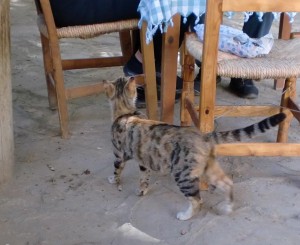 Street cats in Cyprus ats freely approach people for food, and everywhere around houses we see plates with foods or bowls with water for cats and dogs. This is the nice side. There are projects, usually cooperation of private citizens/asylums and local governments, to sterilize and castrate the animals in the street to stop the overpopulation of cats and dogs. This is very nice too. But, strange enough, private owners of cats and dogs refuse to invest in sterilization and castration. Their animals gets youngs and the young ones are sadly left and abandoned in fields, forests or faraway streets: just like that. This is such a shame! And it means there will be no end to the efforts of the asylums and local governments, because new animals keep appearing in the streets
 …
… Go to Nicosia, Cyprus and this museum with a spectacular overview of Cypriot coinage. It looks like a small museum in terms of square meters: just one room within the Nicosia headquarters of the
  Here is a job to do for someone who likes puzzles; one of the last undeciphered languages!