Street cats in Adana (Turkey)

street cat in adanaStreet cats in Adana
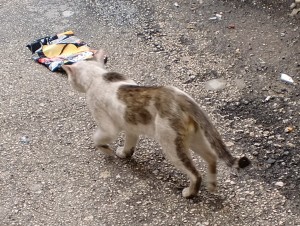
Yesterday I wrote about the street cats in Cyprus; that they are somehow loved, although the fact that they exist in such large numbers shows that the Cypriots do not deal enough with this problem: https://grethevangeffen.nl/2015/06/02/street-cats-in-cyprus/. For street cats in Adana, however, the situation is worse. It can be seen from tstreet cats in adana - kittenhe street cats’ behaviour, they are afraid. It was almost impossible to take pictures of street cats because they would run away immediately like this very small and sad kitten. It really panicked, terrible; it did not think ‘hey here is a friend that will give me some food’. The only cat I could photograph quitely was a sick cat, also quite sad: street cats in adana
If we think that animal behaviour is an expression of local values, there is quite some development work to do for street cats in Adana – they can learn from Cyprus or from Istanbul where things have developed better already for street cats: https://grethevangeffen.nl/2012/03/03/istanbul-and-its-street-cats/.
When cats are either afraid or ill, local values need reflection!

A blog about the great documentary Kedi that follows street cats in Istanbul.

Loin des hommes

loin des hommes  Loin des hommes

I was withholding my breath all the time while watching this movie: Loin des hommes. Algeria 1954, the colonial war or freedom war or however you want to call it, is about to begin. A teacher who’s school is in the middle of nowhere in the Atlas mountains gets involved. He is not looking for that but fate is looking for him. He ends up in several unexpected half war half peace situations. The mountains in the middle of nowhere are much more populated than you’d think: they are full of life, love and fights. Both the rebels and the French find their way over the invisible mountain paths. Will he have to give up his dream, to teach the children how to read? The teacher is also confronted with issues of culture, religion and identity. His parents were from Andalusia, he himself has always lived in Algeria and now others see him as French. There is so much actuality in this movie, it is not just a historical picture. And there is lots of deep warm friendship from man to man in this movie, too. The pictures are stunning. Go there, if you want to see something different!

You can find interesting books about Algeria in this blog and in this blog.

You might also like this blog: When inclusiveness met apartheid

Turist and the myth of heroism

Turist is aturist great movie with many layers and enough humour not to make this too serious a movie. The maker of this movie, Ruben Östlund, has thought a lot about the psychology and behaviour of survival in sudden extreme circumstances like disasters. Statistically, he says in an interview in Het Parool (Amsterdam newspaper) 18/2, most men run away and do not save the women and children. Still, we stay with the myth of heroism in extreme circumstances. It interests Östlund why we do that and we can see that in this brilliant movie Turist. The difference between the myth of heroism we believe in and the confrontation with reality is a fundamental theme in the movie: how to face, how to deal with that reality?
We follow a Swedish model family on their ski holidays in France. Confronted with an avalanche, the father of the family runs away leaving his wife and two children behind. Lots of stories arise from that split second. You won’t be bored. The pictures in Turist are very beautiful. You won’t be disappointed there either. Also, you will learn why to never fly your drone inside the house.

Other posts about movies you might like:
Quand on a 17 ans
Banana pancakes and the children of the sticky rice
Taxi Teheran

Jewish museum Warsaw context

jewish museum warsaw context  Like most tourists I walked in the streets of Warsaw-Center and visited shops like a souvenirshop and a antiquitiesshop. Well, that was quite a surprise.
In the souvenirshop it was possible to buy magnets with symbols of Poland, like one finds magnets with canalhouses, tulips and wooden shoes in Amsterdam. One magnet was a yellow ‘Jewish’ star that mentioned ‘ghetto Warsaw’. I couldn’t believe my eyes, stood there thinking for some time considering whether I should buy it as proof.
jewish star warsaw  But I did not want to buy and thus encourage such souvenirs so I ended making a secret (and not well succeeded) photograph. I am sure that this yellow star would not be sold in the Netherlands but maybe this had a different meaning for the Polish people. I asked in the Jewish museum, showing the pictures but they reacted in a very neutral way, telling that they couldn’t read that it said ‘ghetto Warsaw’ which was true of course 🙂
In the antiquitiesshop it was possible to find all kind of symbols and pamphlets from the last century: communist and anti-communist posters, lots of stuff. I even found a poster in Dutch mentioning ‘Indonesië moet bevrijd worden’ showing an Indonesian guy in chains resisting against a Japanese soldier. As said it was in Dutch and not in Indonesian, this is a real historic thing as Indonesia was freed from the Japanese but then subject to a colonial war with the Netherlands, this poster maybe symbolized that already. The shop also offered Nazi objects. The picture on top and the one below were made secretly in this shop. Maybe it was not necessary to make them secretly, I didn’t know; as a Dutch person I had the feeling that it was a risk to take those pictures but maybe it wasn’t in the Polish context.  nazi stuff warsaw
All together this tourist street gave me many reflections about the context of the new and beautiful Jewish museum in Warsaw, Poland.

My other posts about the Jewish museum in Warsaw:
Jewish Museum Warsaw dilemmas
Jewish Museum Warsaw beauty

Jewish museum Warsaw dilemmas

jewish museum warsaw dilemmas Creating a completely new museum comes with lots of opportunities (that the Museum for the history of Jews in Poland discovered well) and also with dilemma’s. From my visit to this museum I remember two of them.
1. How do you present your history when it has got possibly unfavourable elements? Especially in the light of a history where others have tried many times to present your people as bad people and that this had fatal consequences. The first image of the Jews in Poland happens to be one that connects them to trade of slaves. It was by the way for the first time for me that I learned that the word ‘slave’ is actually connected to the Slavic people, that they were the slaves of the Middle Ages.
jewish museum warsaw6  The image shows Jews trading slaves and a bishop protesting against it; not because he was against slavery as such but because he was against the trade of Christians as slaves. Slavic people were already Christians by that time. Jews are recognizable with a 2-pointed hat. Could this image make actual prejudices increase? Is a scientific approach ‘this is the very first image and thus reality’ the correct one or should the museum be more careful and avoid a possibly bad image? The museum chose to show the 12nd century reality…
2. During war, the Polish were the only people to have an organizational structure to help Jews and this shows their heroic side. Opinions differ on the scale of effectiveness of the organisation. jewish museum warsaw7  How small or large should that part of Polish resistance take in the presentation of the 2nd world war part of the museum? You can imagine the discussions…
Most probably there were many more decisions to take that were a dilemma. What I like about this museum is that the makers are not afraid of decision making and also not of discussing the decisions made afterwards.They are transparent and they are accountable; a great sign of modernity that one can only appreciate!

Two other posts about the Jewish Museum in Warsaw:
Jewish Museum Warsaw context
Jewish Museum Warsaw beauty

Jewish museum Warsaw beauty

jewish museum warsaw beauty

28 October 2014 Warsaw could open the doors of the brandnew Museum of the History of Polish Jews and for certain, that museum is a beauty.
First of all it is a beauty from the point of view architecture. jewish museum warsaw beautyThe size of the museum is enormous which offers opportunities for spectacular projects like: telling the story of the Jews coming to Poland 1000 years ago with moving images on glass walls; rebuilding an old wooden synagogue with all its special paintings; and redesigning a street in a Warsaw Jewish neighbourhood in the 19th/20th century with all its cultural and political activities, see these 3 pictures for an impression.
jewish museum warsaw beauty  jewish museum warsaw beauty jewish museum warsaw beauty
Apart from the special projects you can find interactive expositions for all centuries (I loved the medieval ones), and learn a lot about Polish history in general, too. The way the partition of Poland among other countries in the 18th/19th century was symbolised by a big and empty throne, overlooked by foreign rulers is impressive. Of course many people like to have their picture taken at the throne so it is never empty for a long time. The museum allows this kind of jokes and activities which is very nice.
This is a museum that deserves your time, wandering from one room to another through 10 centuries of history. It is different from other museums: it is an impression, not an explanation. It is an atmosphere and a way to live the lifes the Jews in Poland lived since the Middle Ages. If you visit Warsaw, remember to go there!

My other posts about the Jewish Museum in Warsaw:
Jewish Museum Warsaw Context
Jewish Museum Warsaw Dilemmas

Warsaw Christmas lights (make the world a better place 3)

make the world a better place (3)  make the world a better place (3)  Warsaw Christmas lights make the world a better place. Some cities are good at special Chrismas lightning, some are less good. Amsterdam for example is not so good, not very creative in Christmas street lightning, but they also have the Amsterdam Light Festival (which is not the ordinary street lightning but specific enlightened art objects) and that is rather spectacular. Warsaw in Poland has very good designers for Christmas lights; look at the beautiful pictures. It gives class and style to the city and makes it a real joy to walk around:
  make the world a better place (3)  make the world a better place (3)Make the world a better place (3)
What amused me in Warsaw is that they also have this:
make the world a better place (3)     make the world a better place (3) Some wouldn’t call it class or style but the Polish citizens probably do. At least Warsaw is not afraid to combine these styles in the same street. And the children are happy with it!

Two other blogs in the theme ‘make the world a better place’
Lisbon pavements
Lisbon walking

Naziha’s spring – an outstanding IDFA documentary

naziha's spring  It was a coincidence that I went to an IDFA documentary, I never have / take time for things like that but in this case the maker of the documentary was the daughter of a friend with whom I participate in a Turkish litterature club – yes, all Turkish spoken so you understand I do not speak a lot, however I do read all the books (in Turkish) while not every participant does 🙂
I have to say that Gülsah Dogan presented an outstanding documentary that should be obliged learning material for any organisation involved in the problems of Amsterdam-West families. She has succeeded to make an inside picture about one of the (former) most problematic Dutch-Moroccan families Amsterdam-West has known. And anyone in the public can recognize and feel the characters, the conflicts, the existentialist problems that occur in this story. It is very moving – there were many tears – and the complexity of extreme family situations is revealed. This is a documentary that deserves a price and I hope it will win.
See http://www.idfa.nl/industry/tags/project.aspx?id=5273991f-70a3-431d-836f-264b6b41bce6, for more info and also times to visit next wednesday, thursday and saturday 26/27/29 November. Don’t miss this one! For me, it will still be on my mind for many days; it is really, really impressive!

Find another documentary made by Gülsah Dogan here: The hunt for my father

You might also like: Kurtulus son durak

Grandfathers, Jews and the impulse to act

grandfathers  It is one of the myths in our family history: my grandfather ‘saving’ a Jewish girl from a Nazi. It was in the 2nd World War. In villages, children from Jewish families lived as if they were part of the farmers’ family, trying to escape a certain death when the Nazis found out they were Jewish. A 14 or 15 year old ‘secretly’ Jewish girl, described as very beautiful, accidentilly fell in the village street and bumped her head against a stone right in front of the house where one of the Nazis in charge was temporarily located. He came out of the house, saw the beautiful girl and took her into the house to take care of her. All of the village worried, they were talking about it: what is he doing to that beautiful girl and also, most of all: what if he finds out that she is Jewish? They were extremely nervous!
The worries and talks in the village took a great part of the day, then at the end of the day my grandfather returned from work and heard about it. When he was told, he didn’t even think for a minute but just got angry and went to the house of the Nazi. Did he have a plan? I don’t think so. He did not talk, he did not ask questions, as he never did. He just had the impulse to act.
Did he save her? He didn’t I guess, everybody who was in this story agreed that the girl saved herself once the opening was given. As soon as my grandfather appeared at the doorstep, this ‘wounded’ girl stood up from the couch where she lied down, she ran to the door, embraced my grandfather and acted as if he was her father: ‘o dad, dad, please take me home’. The Nazi guy nodded and my grandfather took her ‘home’.

Summer 2014 we are living a period in Europe, and to my great great regret also in Amsterdam, where antisemitism is fully alive. And just like the village in the 2nd World War, everybody is talking about it. Everybody is ‘worrying’, like all of the village did in the War. But how many of us are acting?
What my grandfather did seems easy > he just went to the house. Anybody could have done that… but nobody did. So the real question is: why didn’t they do it? As the girl could save herself just upon the impulsive action of my grandfather.
I wonder about the conclusion of this story. Doing has more value, more effect than talking? Don’t spend time worrying, just act? Maybe that is true, also today…

Never ever give up

never give up cat  ‘Never ever give up’, a special English friend said to me during the first years of my company. I remember that I told him how much initiatives I took to have more customers and that the phone was so silent… He was very empathic with his reaction ‘yes and then you sit down in despair and think nobody is ever going to contact your company again‘ and he surprised me so much there.

He was a selfmade multimillionaire, I was staying in his ‘house’ (I don’t know how to call a place like that) overlooking the Mediterranean and having parties like I never had before and still he was so down-to-earth that he fully understood my problem as a beginning entrepreneur. He had lived it all himself I guess which felt like a consolation and he could only advice me what had been the best recipe for himself: ‘never give up’.

All this came back to me when I watched Diana Nyad who reached Florida beach after three days swimming starting from Cuba: an amazing and most incredible action. She was not just swimming from Cuba to Florida to set a record, she is setting a major message: ‘never, ever give up’ is her motto. Apparently she is a late believer in realising dreams, as she explains in a most interesting Ted presentation after her 4th attempt to cross that sea full of sharks and jelly fishes: on.ted.com/Nyad and before this recent 5th and finally succesfull attempt. Watch that speech, it is amazing!

She was almost 60 years old when she decided to transform the discontent she felt about herself, about the things she did not do or not change, into the realisation of the dream she had had since 30 years. She failed 4 times, she succeeded yesterday and the first wisdom she spread when she could talk again – apparently it is pretty exhausting, to cross a sea swimming 🙂 – was: ‘never, ever give up’.

Also very beautiful: http://a.abcnews.com/images/US/ht_diana_nyad_jef_120820_wg.jpg
For me her age of 64 years adds to the message, as the crossing of a sea while swimming is rather expected (by me at least) from a young strong person than from an elderly person. ‘You are never too old’, Diana Nyad tells us in her speech and she is right. We usually find too many excuses not to fulfill our dreams and to give up… Mankind is blessed with special people that encourage us to follow our dreams and never, ever give up; may they be blessed too!

Curacao: mixed feelings but rather depressed…

curacao-vlaggen halfstok  Curacao: mixed feelings but rather depressed

All flags were half-mast in Curacao this week. All flags means the flag of Curacao and in exceptional cases also the flag of the Kingdom of the Netherlands that Curacao still belongs to; but just in exceptional cases, because Helmin Wiels who was murdered last week was in support of complete independency – or maybe (sometimes one thinks just too deep and reality is more simple) because no flag of the Netherlands is available in this island of scarcity.
‘He was an important minister’, someone in a bar explains me while we are watching the television to see the speeches for his funeral. I do not dare to say that he was not a minister, he was a parlementarian by principal but my feeling is that this is not the moment to tell ‘better’ to anyone, anyhow. It is maybe a Dutch thing, this desire to be ‘precise’… What is very clear is that people express that they mourn about an important man, a man who cared about their island and who was willing to bring changes.
It also strikes me how happy people are that Dutch government officials are present at the funeral. They point their fingers to them and show me: that is a Dutch official and that person too, they have come to Curacao to pay respect to Herman Wiels. It matters to them that the ‘former colonisator’ is present, regardless the differences of opinion between the Netherlands and Curacao.
There are also people here who are ready to explain you why Helmin Wiels was not the answer to the problems at Curacao. However, the common ground is that nobody denies that Curacao has some real problems, and that it is the poor, mainly black, who pay the price for that.
What surprises me most is the awful, very polluting refinery that is in the core of this island. One doesn’t expect to see this in the Caribbean that are known for their natural beauty. The plant is large and the smell is very bad, also from a far distance and it effects one’s breath. Again it is the poor who live on the side where the wind takes the pollution, and the rich who live on the side where breathing is still possible – makes me sad…
Is this a happy island? No it is not. Everybody is talking about the safety problems here, even more than about the economic problems. I spoke to several people who disliked Helmin Wiels, even hated him; however, now that he is dead, they seemed to have lost hope. At least he was calling for change, and will there be anybody else to fulfill this role?
‘Hier is dat ding gebeurd’, people say in the bus when we pass the beach where Helmin Wiels was shot. My first thought was, what is ‘dat ding’ but I saw the picture and the objects placed at the beach and understood ‘dat ding’. It is too awful for people to be named in exact words. Mixed feeling are felt on this island but all together it is rather depressed…

Read also about the synagogue of Curacao
Or the blog about A Tribute to Charleston victims


Who tells your history? and other questions

  “Who tells your history?”, says another intruiging exhibition in the Stockholm National Historical Museum / Historiska Museet (http://www.historiska.se ). I don’t know what musea are like in your country. My experience is that they are usually knowledgeable on the subject they talk about and also a bit arrogant: they are the experts, the way they present things is right. The Stockholm National Historical Museum is a pleasant surprise, unique in its kind. Here is a museum that questions its own assumptions.
For example the way an archaeologist looks at a prehistoric grave is not just defined by ‘objective’ knowledge but also by his concept of the world he knows. So when he tries to find out whether a prehistoric grave belongs to a man or a woman, he might follow rules like: ‘ah this is a needle, so it was a woman’ and ‘ah this is a weapon, so it was a man’. How can we be sure that this is prehistoric reality and not the archaeologist’s concept of the world, projected on prehistoric times? We can’t, the Stockholm National Historical Museum simply says. This museum does something more courageous than I even saw a museum do: contest its own authority, expertise and knowledge. Isn’t that a great example for the 21st century where certainties have diminished anyway!
It is not just a non-issue that they are talking about, as you can read in a previous blog of my hand, april 2011: https://grethevangeffen.wordpress.com/2011/04/12/gay-caveman-in-czech-republic/
The Stockholm National Historic Museum makes this matter personal (see the photograph above). Many people define their identity by the (national) history; be it viking, be it VOC mentality, be it slavery, be it the Ottoman empire. But as the museum says, it matters who defined that history with what concept. This museum questions the possibility to define your identity through history, as it might be a construct rather than a truth or reality. I loved it – I found it very intriguing. If you prefer questions to answers, don’t forget to pass by this museum when you are in Stockholm. Enjoy!

Another blog about this museum: Vikings, did they really exist?

Another museum that you might like: Heimatmuseum Borkum: variety, wealth, surprise