

In Turkish on this picture: ‘Love means sharing. With a cup of food and water, you can fill the stomach of a street animal. Signed by the volunteers of goodness”
The way people care for cats and dogs in their streets is a sign of deeper values, I wrote in earlier blogs Street cats in Northern Cyprus, Street cats in Adana and Street cats in Istanbul. In Famagusta / Gazi Magusa on Turkish Cyprus, dogs and cats are not always taken well care of but they are usually at ease. 
Especially the street dogs in Famagusta are friendly, welcoming visitors and keeping them company while they climb the century old walls that the Crusaders under the rule of the Lusignan Kingdom built around old Famagusta. You’d take the lovely dog home with you immediately, if you could. People tend to warn you for the stray dogs, telling you they will bite but it is unclear where this fear comes from.
Most inhabitants of Famagusta are kind with the street dogs and cats. We just saw one incident when four Iranian students wanted to enter a restaurant where a stray dog was lying on the doorstep and one of them made a point about it. However, the personnel didn’t give any reaction to the comments made – maybe because it was in Farsi and they didn’t get the point of the problem – and the three other students convinced the fourth one to get over it; which he litterally did. This shows how great the influence of others can be, and that you can also make a difference! In general street dogs in Famagusta were given a home, or food at restaurants: see these pictures:


Love means sharing, as the picture above tells those who pass by on different corners of Famagusta. Apparently since a short time, local governments are obliged to care for street animals. Not all of them are doing it yet, but it is a start. The friendliness of Famagusta is a good start!

 Compared to my childhood visit many elements were added in the ‘museum’; quotes on walls or on blinded windows – short video’s from witnesses, classmates of Anne and the like. They are very impressive.
 I really thank the Anne Frank House for this opportunity. I wonder why this does not become more usual in Amsterdam. As for me, it is not about the free ticket, but the fact that I could go at 21.00h (I came home from work only at 19.30 and had to have dinner first) and that I did not need to wait in a queue or go in with plenty of loud speaking tourists. Would it be financially difficult for musea to have similar evening offers or are they just not used to opening hours in the evening?



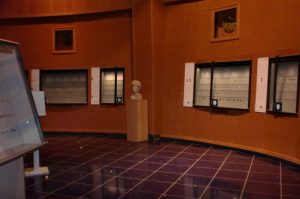
 Already in the first century of islamic era, coins were made with Qu’ran inscriptions and this museum shows a good quantity of them (a lot in gold, part of the attractiveness of course).

 And it presents plenty of memorial coins, and coins of special sites where I found Amsterdam among them.
 Last but not least: the library they have offers books in 5 or 6 languages, not just about coinage but also about history and art of the region. It is an excellent collection for those who want to study and it seems to be an undiscovered place: you can sit there in complete tranquillity, surrounded by friendly workers who are happy to welcome anyone interested in their cultural heritage.
 Dat Nederland of ‘het Westen’ iets kan leren van het Midden-Oosten staat voor mij inmiddels wel vast. De komende maanden onderzoek ik dit verder, al (samen)werkend in de praktijk, op weg naar vertaling voor westerse organisaties. En net als in de vorige blog, nodig ik graag mensen met ervaring in die regio uit te reageren ter bevestiging, nuancering of ontkenning van mijn conclusies of aanvulling daarvan. Wordt vervolgd!


 Ramallah is a lively and kind city. During a short trip through the city, at least five people said spontaneaously ‘welcome’ to me. Isn’t that nice? I love tourists in Amsterdam (except when they walk on the biking paths) but I never tell them ‘welcome’; maybe that is a good thing to learn from the Palestinians here! It makes life more beautiful…
 Ramallah is also a contradictory town where you can buy the biography of Hillary Clinton at several places as well as Mein Kampf from Hitler, both in Arabic. I met with some police officers who were nice and accepted to have their photograph taken; another spontaneous move I guess, in this region where officials usually say no.
 Nevertheless, with 25.000 people, Sderot has a shopping center. The parking lot in front of this shopping center counts 3 concrete shelters so that everybody who comes to the center can be sure to find safety on time when he/she will be surprised by a rocket while shopping. They sell nice stuff and they are really surprised when you buy a shirt but don’t speak the national language; Sderot is not a town where tourists use to pass by….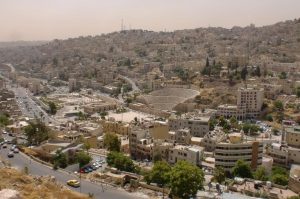

 The museum has some spectacular pieces that in Western museums would be presented with lots of pooha. However here in Amman they are shown in a very modest way. This is a pity because if you do not know, you might overlook the uniqueness of the findings. I spoke very enthusiasticly to a Jordanian woman about the museum and the artefacts I saw there and she thought deeply and said in surprise: ‘I was there but I must have missed that, I do not remember at all’.