

Gaziantep castle (Gaziantep kalesi, also called: the panorama museum) goes a long way back: most probably the Romans already had a first fortress on this rock, followed by the Byzantines, Arab rulers, Selcuk and Mongol rulers and whoever passed by in this region: the list of different rulers is long. Going to Gaziantep castle means having a perfect panorama over the city.  It is nice and well enough restaured for a good impression what the castle was like in the old days.
Moreover this castle is used as the expression of Antep’s heroism. The people of Antep played a crucial role in the War of Indepences in 1920-1921 and were honoured by Mustafa Kemal Atatürk with the title ‘Gazi’: great, heroic. The war of indepence came after that the Osman emperor and its calliphate were defeated; Turkey was attacked from all sides, by the English, the French, the Armenians, the Greek, the Russians: they all wanted their share of the remains of Turkish territory. Under the leadership of Atatürk a war of independence started and they won. This is seen as the ultimate survival of Turkey – without this war, Turkey would no longer exist and Turks would not have a land of their own. Five or six thousand inhabitants of Antep lost their lives in that war but their role was decisive. The Gaziantep castle shows this history and the pride, the nationalism of this town.  Lots of kids are visiting the castle to learn about the war but also many Turks from Gaziantep and elsewhere show indepth interest in the exposition.
All the written texts are in Turkish and English, the film is only in Turkish. If you want to understand the politics and national feelings of Turks in the past and the present, this is a must-go. 
A disadvantage is that they feel the need to copy the fights. During the whole exposition, you will hear the sounds of guns and artillery; it can make you nervous and I do not see the purpose it serves. But apart from that, I’d recommend a visit. It is another, however non-critical example of how people interprete and write their history (see my blog about the Stockholm Museum), in relation to the actual context.
 More on this subject: the War Museum (Savas Müzesi) in Gaziantep
Other short info about the castle: https://www.alaturkaturkey.com/destinations/gaziantep-castle.html
A blog about another nearby interesting site to visit:
A kastel is not a castle in Gaziantep

 Also they have touchscreens where you can look up the mosaic you prefer and watch it in detail; or another touchscreen where they show you ‘land’ and you have to guess which mosaic lies under the ground. The only thing lacking is the translation of Greek texts: some mosaics show texts and you’d like to know what they say. You’d expect a museum to explain that to its visitors…
 1. The Gypsy Girl, who has somehow become the symbol of Gaziantep; she is everywhere in the streets, in shops, on the airport. They gave here a special place in a dark room where no one enters without the presence of a museum guard. And there she is, in the dark, brilliant and mysterious in the same time, uniquer than unique among all the mosaics. Indeed it is a masterpiece. While I was standing there alone in the dark, she seemed to look right through me…
 2. The Galateia mosaic, seen from above. Some mosaics have more worked out details or fuller images. I liked this one because of the balance and the colours. A description of the Galateia story can be found on the website of the museum (in English and Turkish, if you like),
  3.The out-of-the-box mosaic. I haven’t got a clue what it is but I adored it immediately. It is one of the more recent mosaics. Apparently, in that period, they started to put images in the mosaics just where they wanted – at random – no apparent rules were followed any more. I imagine that it was a breakout from all the detailed work that was done during ages; and how free it felt and how it was criticized by traditionalists and knowledgeable people and all those who feared that craftmanship was now about to disappear, to be replaced by art work that ‘even my three year old son can make’.
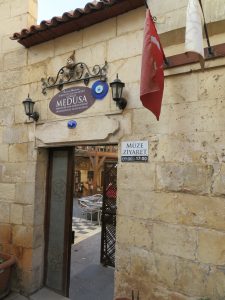 yet rather small in size and hidden in a back street.
 If you think like me, that ‘old’ starts at least in the era BC, this museum is your place to be! Some examples: they got a range of children’s toys (‘cars’) from the early bronze age (3000-2000 BC). The picture shows 2 of them. They got lots of gold from 100 BC
  (Greek). While I was watching it, I looked around full of sorrow: was this place really well protected? The Medusa Museum gives you the idea of a home, rather than a museum with full security equipment… I thought (you never know).
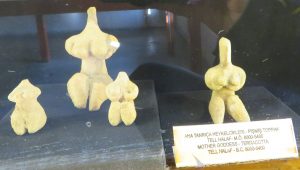 They reminded me of findings in Malta, where the same kind of mother goddess or fertility statues were found and nobody can explain what culture they belonged to, what they mean. There is a similarity with the figurines shown in the Medusa Museum which would support the theory that in ancient times certain places served religious rituals with regard to fertility and/or the female godess.
 e. To finalize: there is some amazing Roman stuff (more recent, 100-200 AC):
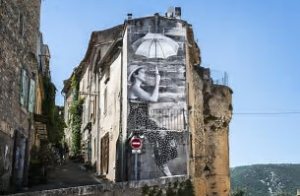
 the only inhabitant left in mine workers houses, almost forgotten by the world, becomes a monument of resistance; and so on. What is absolutely unique about this road movie that could also be called a road documentary, is the normality shown in its full brilliance. It shows that normality can be infinitely more interesting and great than the special.
 From a vivid wheelchair run through Musée du Louvre in Paris to sharing sadness and perspectives on life: it forms one breathtaking story for the spectators.
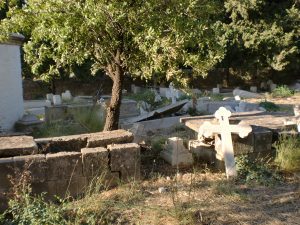 (the Turkish side), the Greek graveyards may have been destroyed deliberately as they are all in a devastating state. The situation for Turkish cemetaries in the South of Cyprus (the Greek side) is different, he says. This raises questions about why this is the case and M. Thorsten Kruse comes – roughly – to conclusions as I formulated in


 give up hope for Arab leadership and think that the French offered more. Boudjedra shows how cruel the French regime has been in Algeria; even though that did not improve after the Algerian independence, that does not mean that he feels nostalgia for the French colonial times in Algeria, on the contrary: he is rather inclined to conclude that cruelty and barbarity is part of human history, in whatever shape or nationality.
 Mijn ontdekkingstocht naar diversiteit & inclusie in Arabische landen gaat verder, ditmaal via diversiteit in Marokko en Tunesië. Na de start in Jordanië (
 In Marokko werd ik daarbij nog verrast door de grote persoonlijke warmte van de deelnemers. Hard werken ging er gemakkelijk samen met positieve emotionaliteit, Een deelneemster gaf me na afloop haar prachtige oorbellen mee, als aandenken namens de hele groep.