Ramallah is a lively and kind city. During a short trip through the city, at least five people said spontaneaously ‘welcome’ to me. Isn’t that nice? I love tourists in Amsterdam (except when they walk on the biking paths) but I never tell them ‘welcome’; maybe that is a good thing to learn from the Palestinians here! It makes life more beautiful…
Ramallah is also a contradictory town where you can buy the biography of Hillary Clinton at several places as well as Mein Kampf from Hitler, both in Arabic. I met with some police officers who were nice and accepted to have their photograph taken; another spontaneous move I guess, in this region where officials usually say no.
The kindness and politeness of this city’s inhabitants is in strange contrast with the attitude as soon as ‘politics’ enter the arena. Faces become rigid, attitudes harshen, voices turn loud. The people of Ramallah and the Westbank suffer real hardship because of the Israeli occupation. They tell you heartbreaking stories about it, and you don’t want anybody to live that, themselves or with their children.
Somehow, Isreali’s or Jews are to blame for everything here. Most of all I was surprised about the story of a Christian Palestinian who said there is a Jewish plan to remove all the Christians from the Middle East – not just the Westbank – so that the Jews can have all the land and the Americans can claim that Christ was born in the US (in New Jersey for example) and not in the Middle East. When the Americans chased Saddam out of Iraq, they looted the musea of Iraq and sent all the stolen antiquities to Israel so that the real archaeological history could be wiped out. I always thought the Americans didn’t have a clear plan in case they’d win in Iraq and they just forgot to protect the musea but here they are themselves deliberately looting the musea, following a deliberate plan they have together with ‘the Jews’.
My Christian Palestinian continued by telling that the Jews left Egypt and they also left Babylon 7000 years ago and now they want this land, Palestine, for themselves. Wasn’t leaving Babylon closer to 2700 years than 7000 years ago? I am just guessing but 7000 seems way too long ago. ‘Yes’, my Christian Palestine friend says, ‘of course 2700 years ago, that is the same, they left Babylon’. I do not think that that is the same in the ligth of the discussion we are having but my view is ignored.
He thinks the Jews are behind the removal of the Christians from Iran, Iraq, Palestina, Egypt, Syria, Turkey, Libanon and maybe more countries. It is evident that during the last 40 years Christians have been fleeing the Middle East and I have been quite involved in that but this is really the first time in my life that I hear someone tell that this stems from a Jewish plan. How this would serve the Jewish case is not clearly explained. What matters is that ‘they want this country from the sea untill the river since the 19th century’. The Jews crucified Jesus and now try to remove the Christians from Middle East countries. The Americans work with them because that will help them to turn Jesus into an American born citizen.
A nice conversation just turned into a conspiracy theory that divides us into two worlds… I do not know what to answer. I just remain speechless.
Category Archives: Culture and diversity
Diversiteit in Jordanië: business as usual?

Diversiteit in Jordanië, dat was voor mij nieuw. Toen ik via een Duitse opdrachtgever de vraag kreeg of ik in een bouwbedrijf in Amman – de hoofdstad van Jordanië – een diversiteitstraining wilde geven, zei ik meteen ja maar was ik ook wel verbaasd en een beetje onzeker. Ten eerste had ik een dergelijke vraag niet verwacht vanuit de bouwsector in Jordanië (ziedaar, uw diversiteitsexpert is niet vrij van vooroordelen). Ten tweede was ik nog nooit in Jordanië geweest. Diversiteit is bij uitstek een contextafhankelijk onderwerp en als je uitgaat van diversiteit als businesscase, wat ik doe, moet je terdege weten waar de businesskansen liggen voordat je iets zinvols kunt bijdragen aan diversiteit in Jordanië. Maar ja, zo’n kans krijg je niet elke dag en ik ben altijd al een fan van het Midden-Oosten geweest…
Zo toog ik enkele weken later, na een visum te hebben gehaald bij de Embassy of the Hashemite Kingdom of Jordania in Den Haag en bovendien alles bestudeerd te hebben wat er over het Hashemite Kingdom te bestuderen valt, naar Amman. Na enkele dagen doorgebracht te hebben met ingenieurs, architecten en HR-functionarissen kom ik tot een paar conclusies over diversiteit in Jordanië die ik graag nader zou willen testen:
1. de cultuur in Jordanië is conflictmijdend, mensen leren van jongsaf aan reacties in te schatten en confrontaties te vermijden. Mensen hebben daarom antennes ontwikkeld om te voelen hoe dingen liggen zonder dat ze verbaal worden uitgesproken. Als trainer viel me op dat de deelnemers vaak aan een half woord (of aan mijn gezichtsuitdrukking) genoeg hadden; waar Nederlanders of Duitsers behoefte hebben aan explicitering, kunnen ze in bedrijven in Jordanië ook zonder (ik zeg dus niet: heel Jordanië, het gaat over de zakelijke omgangsvormen).
2. het zakenleven in Amman wordt niet, zoals te doen gebruikelijk in Nederland en Duitsland, geplaagd door schuldgevoel. Waar in een diversiteitstraining gewezen wordt op patronen van uitsluiting, of het nu gaat om gender, cultuur of religie, kunnen deelnemers er vrijelijk om lachen en zich onbevangen afvragen: waarom doen we dat eigenlijk zo?
3. de waardering voor objectieve kennis is groot. Diversiteitstrainingen worden met name in Nederland geplaagd door mensen die ‘een mening’ hebben. In Duitsland is er meer waardering voor bevindingen uit onderzoek en wetenschap en in Amman is dit ruim aanwezig: er is ronduit honger naar kennis. Wetenschappelijke resultaten vinden een open oor en ambitie voor toepassing.
Mijn ervaring met de Duitse opdrachtgever en het Jordaanse bedrijf was zo goed dat ik in juli terug ga voor een vergelijkbare training bij een telecom bedrijf in Amman. Ik ben benieuwd of mijn conclusies (hypotheses) over diversiteit in Jordanië stand houden of gewijzigd worden – hierover zal ik zeker een nieuwe blog schrijven. In het dagelijks leven horen wij meestal negatieve berichten uit het Midden-Oosten. Toch zijn daar bedrijven die al sinds jaar en dag succesvol met diversiteit omgaan, want het Midden-Oosten = diversiteit. Zonder die kerncompetentie kun je daar geen bedrijf runnen. Ik vermoed dat het Westen daarvan kan leren en heb de ambitie daarover meer te ontdekken en dit te vertalen naar de westerse context en behoeften.
De komende maanden ga ik ook naar Israel en Tunesië en mogelijk nog andere landen. Ondertussen ben ik benieuwd naar reacties van mensen met ervaring in die regio ter bevestiging, nuancering of ontkenning van mijn conclusies of aanvulling daarvan. Neem gerust contact op en wordt vervolgd!
Archaeological Museum Amman: caring for 6500 year old child…

Today I was very moved when I saw the estimated 6500 year old remains of a buried child in the Archaeological Museum Amman, at the Citadel. The museum shows many artefacts, neutrally placed on glass or wooden shelves. However, this child got special care: it was placed on a soft, warm cushion. Is there a better way for a museum to show that they care? is there a finer way for Jordanians to express their culture of respect?
Culture is not a matter of big flags and statues, although I admit they can be part of it. Culture is often recognized from little, tiny details in daily life, such as the care for a child that has died not just centuries but thousands and thousands of years ago. This museum shows that even after so much time, it is possible to surround a child with love. Wow Jordan… It really touched my heart!
The museum has some spectacular pieces that in Western museums would be presented with lots of pooha. However here in Amman they are shown in a very modest way. This is a pity because if you do not know, you might overlook the uniqueness of the findings. I spoke very enthusiasticly to a Jordanian woman about the museum and the artefacts I saw there and she thought deeply and said in surprise: ‘I was there but I must have missed that, I do not remember at all’.
So if you go pay a visit to the archaeological museum at the Citadel of Amman, do your homework beforehand and you will enjoy your visit tremendously because nowhere in the world you can find older statues than here: really! And while you’re there, don’t forget to pay your respects to the chalcolithic child that most probably had loving parents and is now taken care of by loving Jordanians.
The sign in front of the child says: ‘The burial of infants in jars was a common custom in Mesopotamia, Egypt and Palestine. The jar was generally placed under the living room floor, possibly to keep the child within the family circle‘. (Ghassul, Chalcolithic).
Chalcolithic means: 5500-3500 BC.
One other real old, real interesting museum: Archaeological Museum Gaziantep, Turkey
And this one, also in Gaziantep: Medusa Glass Museum
And this one, in the Netherlands: Archaeological Museum Haarlem
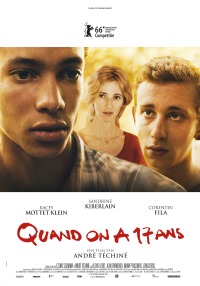
Quand on a 17 ans

Another one of these great French movies: Quand on a 17 ans (being 17). French art means that the story is multilayered; the story does not run from one action to the other but shows the diversity of events happening in just a few people’s lifes in a mountain village high in the Pyrenees.
That setting is great, absolutely well chosen and beautifully exploited. You’ll see the nature of high mountains in different seasons. The very best scenery is at night, in the snow white mountains and the moon shining, when one of the main characters takes a bath in a lake reflecting the peak and the trees.
The main story in Quand on a 17 ans is about two young guys who seem to hate each other, but guess what at the end of the movie… 🙂 in that sense it is a quite romantic movie where ‘tout va bien qui finit bien’. The road to that good ending has enough complexity in it to keep the spectator interested. Apart from that, there is life in the movie and death and all human weaknesses and anxieties as they can be lived, even high up in the mountains. Quand on a 17 ans is worth watching!
Blogs about French movies:
Loin des hommes
Visages villages
Panagia Melandrina church – Northern Cyprus heritage (18)

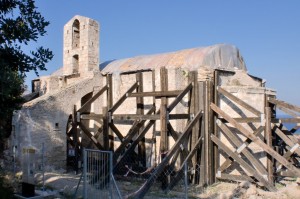
Finally we found the Panagia Melandrina church. We would not have managed without the help of an only-Turkish speaking but all-knowing worker at the Belediye (city hall) of Esentepe : friendly and enthusiast to help us out. After a search of several days for the Panagia Melandrina church, it was a joy to find it but a disappoinment to see it. UNDP and EU invested recently in ‘emergency measures’ to save this church (see UNDP-info Panagia Melandrina). I really wonder why they chose this church out of so many churches that could benefit from their time and effort.

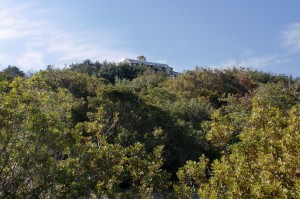
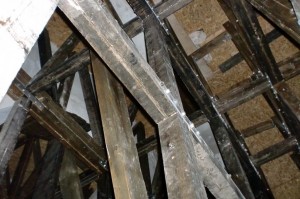
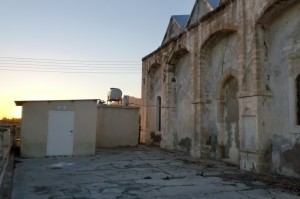
The Panagia Melandrina church lies in the middle of bushes and fields not far from the coast at the harbour location of Esentepe and it is in fact a ruin. It goes back to the 15th century and did have wall paintings as they were reported by an historian in 1896 but those have disappeared long ago. The monastery this church was part of, was active till around 1940. The efforts and investment of the UNDP and EU mean that the church is prevented from total disaster with countless wooden polls : see the photographs.

A roof was made and it is covered in plastic (partly torn already), also two of the outside ailes are covered in plastic. One wonders whether that does any good to the fragile remains, especially in humid times. Unless you are interested in sites like these anyway, there is not one reason I could think of to recommend to you a visit to the Panagia Melandrina church. There are a lot of other, more beautiful and less annoying antiquities to see in Cyprus.
Both the UNDP-findings and information on sites like this site indicate that the church may be built on an older temple or other remains. That is very interesting as this is also the area where some of the rather unknown Mezar Houses, the underground houses of the 10th century would have been found. In some cases, one can go for what one can see. In this case, I’d spend my time and investment on what could be underneath the surface…

Another church near Esentepe: the Abadi church
And in Esentepe center: Agios Ambrosius church
Abadi church – Northern Cyprus heritage (17)

We were looking for the Melendirina church – a church that was on an urgent list for reparation on UNDP initiative in 2012 – when we came across the Abadi church. At first we did not know at all what kind of church it was; there is absolutely a lack of information about the churches in the Esentepe / Agios Ambrosius area. Any information you look for leads you to the Antiphonitis monastery – see our blogs Panagia Eleousa church and Agios Mamas church for the rest, churches seem to be considered uninteresting or non-existent. That is such a pity as we showed in the blogs 14, 15 and 16 of this Northern Cyprus heritage series that there is a lot to be discovered. Esentepe is not a touristic area which might be the reason why it is so difficult to find out more about the specific sites.
It was not clear how to get to the Abadi church when we saw it, driving our way through the mountain forests above Esentepe; so we ended up by just parking the car among the trees and walked our way up to the mountain. And there it appeared, the Abadi chapel, in all its beauty. Alas it was closed so we could not see the inside. The doors of the chapel looked quite new which gave us (born from experience) the idea that there was nothing inside any more and that doors were placed recently to protect the last bits and pieces. Please try to enter one day and prove us wrong.

As we had no clue about the chapel, its name or origin, we concluded from the surroundings that it had had a courtyard with beautiful trees, so it was an important center, some time, some day. Later we read on internet that it had been a monastery that was ruined and that a small church was built to replace the institute. So this is some kind of hidden secret in the middle of the forest on the hills above Esentepe / Agios Ambrosius…
Panagia Eleousa church – Northern Cyprus heritage (16)

Panagia Eleousa church in Tirmen/Trypimeni is another church that was turned into a mosque after the Turkish army took hold of Northern Cyprus in 1974. The church seems to be in a reasonable estate, just like the village itself that is not the wealthiest village to be found in the area either. The village lies right on the south side of the Pentadaktylos mountain range and overviews the Mesaoria plain that separates the Troodos mountains on the Greek side from the Pentadaktylos mountains on the Turkish side. Apparently the Mesaoria was a sea in very old times; so the symbolic separation was already there in history…

The only information that I could find about the Panagia Eleousa church is that it was built in 1900. I was wondering about the tower, it seems to be a different style than the church, made from different materials, attached to the church externally from the side and put right in front of an opening fence; all this suggests that it was added later. The Panagia Eleousa church is more beautiful without it. 
The clocks from the church tower are missing. For the use of the mosque some small details were added like cleaning rooms and they are quite ugly.
If you have more info about the Panagia Eleousa church, feel free to comment. In this Northern Cyprus heritage series there are other blogs showing churches that were turned into mosques after 1974, see Agios Ambrosius church and Agios Mamas church.
Agios Mamas church – Northern Cyprus heritage (15)

Agios Mamas church
In Bahceli (Kalograia), about 20 miles east from Girne, there is another church that was turned into a mosque at an early stage, already in 1975 so very short after the Turkish army took hold of the Northern part of Cyprus. It is the Agios Mamas church Bahceli, named after Saint Mamas who lived in the 3rd century and seemed to be quite brave – his best companion being a lion. Read some more about him at http://orthodoxwiki.org/Mamas_of_Caesarea .
From the outside the church seems to be in a reasonable stage – note that the village itself looks rather poor. Only the clock tower is at risk
as the picture here shows. The clock itself is still there but seems to have fallen down and rest on the wall sides.
We have not seen the inside. I could not find a lot of information about this church at all. Those who know more (facts), feel welcome to comment.
Agios Mamas is not the only church in this region transformed into a mosque, read also Agios Ambrosius church , another blog about Tirmen/Trypimeni will follow. You can find it here: Panagia Eleousa church

Agios Ambrosius church – Northern Cyprus heritage (14)
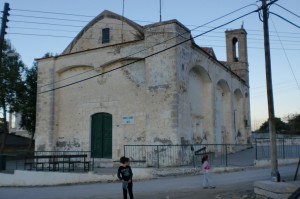
In Esentepe, a small town about 20 miles to the east of Girne, we find the Agios Ambrosius church that has been transformed into a mosque in 1978 already; this happened in more villages in this part of Northern Cyprus (other blogs will follow). Agios=Saint Ambrosius was a very influential bishop of Milan and a Doctor of the Church in the 4th century. The Agios Ambrosius church was built in 1867 out of yellow stones and characterizes very much the Byzantium architecture. It seems to be in quite a good state (we did not see the interior but the exterior looks fine) and in general inhabitants take care of the city center where it stands.
Actually with the peace talks between North and South Cyprus making progress, the question is raised what will happen to churches that were turned into a mosque. Time will tell… first bring the peace talks to a good end, then solve this too.

Other churches near Esentepe:
Abadi church
Panagia Melandrina church
Dheepan: an outstanding movie about refugees

Dheepan is somehow a ‘neutral’ movie about refugees as it concerns refugees from Sri Lanka; I worked with many of them in the ’90ties but today we concentrate on other regions as every reader knows. Technically this choice in the movie creates a healthy distance to emotions in actuality. And practically, it makes no difference.
Refugees run for a reason, most often a quite serious one. And yes, they are surrounded by luck-seekers, criminals who have other reasons to flee and economic migrants. Making the difference between one and the other is an ideal but in practice not very easy. However the movie is not about asylum policies and dilemmas, it is about how people flee and become a refugee and how they experience the country in which they arrive.
In this movie, the Sri Lanka refugees find a house and a job in the banlieu of Paris, in one of the worst banlieus – I think the movie maker even wanted to point out that the refugees run from a war to end up in another one. It is as much a complaint against the ‘drugs in banlieu’ situation as about the refugee situation. Specifically, the total lack of law enforcement (no police or authorities at all) surprises the public.
I think the movie is brilliant in the way it depicts the refugees. I recognized every emotion, both in daily life and in the history of violence and resistence that refugees from war and conflict areas bring with them – not as a choice but as a fact. My experience with that is both friendship and work and I found the movie Dheepa shiveringly realistic and very strong in the way of showing the emotional side.
As a former French teacher, I regretted that the refugees end up in England – to their satisfaction – and not somewhere else in France, a country I love. This is, of course, a biased view 🙂 Anyway the movie ends well, which in a world of problems is nice and more encouraging to go and watch the movie than the opposite.
What surprised me is that nowadays every discussion and debate in the Netherlands is about refugees but we were only 8 spectators: 8! in a large cinema. Sometimes I wonder how much indepth knowledge people want about reality – I see loads of over-emotional people and few people able to handle the complexity that comes with refugee issues. Let’s face reality even when it is not simple. Go watch the Dheepan movie, warmly recommended!
Other blogs about refugees:
500.000 Syrian refugees in Gaziantep
Lore, a movie that silences the public
Banana pancakes and the children of the sticky rice
Banana pancakes and the children of the sticky rice is a great documentary about two guys, or maybe an entire village in Laos in a period of starting tourism. The place is still ‘all natural’ and the first tourists arriving, mainly backpackers from France, Belgium and the Netherlands, are startled by the purity of the place. The village develops in many aspects and the two guys that are particularly followed in this documentary try to improve their life by offering touristic services. The road they go is so interesting!
The tourists themselves are also quite interesting, some of their conversations are recorded. They have their opinions about life in the village and how it develops and it does not seem to match a lot with the culture and desires of the villagers themselves. Although very sympathic, there was also a note of arrogance in their song.
From the point of view ‘image taking’ the documentary has quite some ‘vague’ moments, maybe nice as a hobby for the filmer but for spectators not always attractive I thought. Fortunately, many good and sharp moments offer enough compensation 😉 So go see this documentary now because usually this kind of movies do not stay long in the cinemas. More info: https://www.facebook.com/laosdocumentary
Other movies with a strong cultural side I wrote about that you might like:
Kedi
Dheepan
Taxi Teheran
Taxi Teheran
How to make a movie that is only playing in a taxi and does not bore any minute? Taxi Teheran is a succesfull try-out of that concept although not by free choice alone. Jafar Panahi, maker of the movie and also its main character has a history of struggling with censure and oppression in his country Iran. He is not allowed to make movies during 20 years and this movie, Taxi Teheran, was made secretly and smuggled out of the country.
The movie is very funny with many surprising moments, and it has a groundtune of sadness underneath. As such, it is very Iranian: Iranians usually are well developed, social, bright and full of life, they know how to make the best out of difficult circumstances. But that does not mean that they do not feel the difficult circumstances, especially the oppression.
In Taxi Teheran we see a wonderful mix of people entering and leaving Jafar Panahi’s taxi. Even the concept ‘taxi’ in Teheran is different from other countries and that in itself creates unexpected situations. Taxi Teheran shows a lot of interesting interaction between a variety of inhabitants of Teheran. And it gives some great insights in the well developed double face of Iran, in survival and creativity against the odds.
Other movies I wrote blogs about and that you might like:
Banana pancakes and the childres of the sticky rice
Visages villages