Green Line Nicosia – Cyprus

green line nicosia saray hotel 4   nicosia green line saray hotel 5
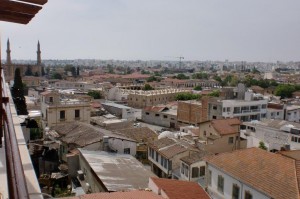
Look at the Green Line Nicosia – Cyprus from above in these pictures and you can easily see 2 cities here: the Turkish one, in front and the Greek one, further away.nicosia green line UN post Nicosia Invisible here, inbetween the two city parts lies the Green Line, a 100 meter large strip where the UN rules since 40 years (!) to separate the Greek Cypriots from the Turkish Cypriots… Easy to understand how bored the UN-soldiers are here, they just ride around in expensive UN-cars as there is nothing else to do. The fighting has stopped long ago and the frontier is even ‘open’ since 2003 at three points at the Green Line Nicosia. Parties make small steps forward that symbolize progress like the abolishment of giving stamps every time a person crosses the transit point; this step was the first result of the new peace negotiations that started 2 weeks ago. It lead to quite some confusion especially at the Turkish side: the protocol had to change but Turkish officials love stamps – clearly that was really a thing to give up for them 🙂 Anyway the international community was investing here at least 30 years in vain, paying for useless UN-presence, boycoting the North / Turkish side without any result. For how long will we continue to do so? And why?
Nnicosia green line greek soil versus turkish sideinicosia green line turkish soil versus greek sidecosia could be a beautiful and flourishing city but it is not because it has no heart but a Green Line, a real wall in the middle of it: see the pictures, where we walk on the Greek side with theTurkish Cypriot and Turkish flags on the old city walls, and the walk on the Turkish side limited by a sudden wall to stop us going to the Greek side: no entrance, no photographs allowed either by the way.
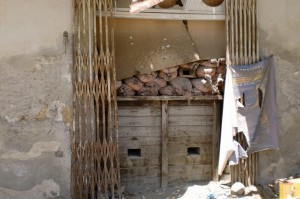
I found the transit point at Ledra Palace the most sad one I have seen so far, although there are several peace seeking initiatives in the buildings there (and also the German Goethe Institut as if nothing happened, very funny). This transit point is at the Greek side surrounded by despair, no investment, no renovation, and even 40 year old remains of fighting (kept there deliberately?):
nicosia green line house at ledra palace  nicosia green line remains of fighting close to ledra palace
Coming from the city of Amsterdam where we love to restore houses and to let original beauty come out at the max, I have to say my hands were itching to take on the job. But well, there is certainly a reason for the non-investment and Nicosia will stay a city without a heart untill the political problems are solved – I hope: soon!

What to do in Nicosia as a tourist? Go to the Museum of the history of Cypriot coinage.

Want to read political stuff? Read about the so-called Freedom Day in Northern Cyprus

Street cats in Adana (Turkey)

street cat in adanaStreet cats in Adana
Yesterday I wrote about the street cats in Cyprus; that they are somehow loved, although the fact that they exist in such large numbers shows that the Cypriots do not deal enough with this problem: https://grethevangeffen.nl/2015/06/02/street-cats-in-cyprus/. For street cats in Adana, however, the situation is worse. It can be seen from tstreet cats in adana - kittenhe street cats’ behaviour, they are afraid. It was almost impossible to take pictures of street cats because they would run away immediately like this very small and sad kitten. It really panicked, terrible; it did not think ‘hey here is a friend that will give me some food’. The only cat I could photograph quitely was a sick cat, also quite sad: street cats in adana
If we think that animal behaviour is an expression of local values, there is quite some development work to do for street cats in Adana – they can learn from Cyprus or from Istanbul where things have developed better already for street cats: https://grethevangeffen.nl/2012/03/03/istanbul-and-its-street-cats/.
When cats are either afraid or ill, local values need reflection!

A blog about the great documentary Kedi that follows street cats in Istanbul.

Street cats in Cyprus

street cat in cyprus 2


Street cats in Cyprus

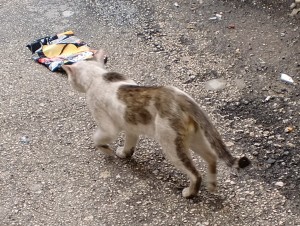
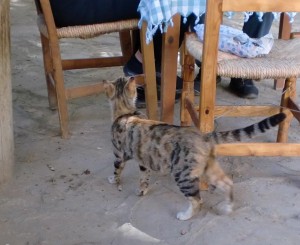
Cyprus is not a poor area in the world. People in Cyprus do have their struggle with daily life but they could do better with cats and dogs than we see them do now. In this case, the North and the South of the island (Turkish or Greek Cypriot) are alike. They are kind to the animals, for sure, and that is nice. One can recognize gentle people from the fact that the cats and dogs are not afraid. The street cats in Cyprus as well as the dogs see mankind as their friends, although the responsibility mankind in Cyprus takes is only partial.
street cat in cyprus 3Street cats in Cyprus ats freely approach people for food, and everywhere around houses we see plates with foods or bowls with water for cats and dogs. This is the nice side. There are projects, usually cooperation of private citizens/asylums and local governments, to sterilize and castrate the animals in the street to stop the overpopulation of cats and dogs. This is very nice too. But, strange enough, private owners of cats and dogs refuse to invest in sterilization and castration. Their animals gets youngs and the young ones are sadly left and abandoned in fields, forests or faraway streets: just like that. This is such a shame! And it means there will be no end to the efforts of the asylums and local governments, because new animals keep appearing in the streetsstreet cat in cyprus 1
A few years ago I wrote this in a blog about Istanbul street cats: ‘Changes can sometimes be perceived in small signs that function as a symbol for deeper lying norms and values. Being valued as a human means that one can value an animal as an animal and embrace animals in their very existence close to mankind. Once the concurrency for food and survival is gone, care can be deployed”. https://grethevangeffen.nl/2012/03/03/istanbul-and-its-street-cats/
What could bring Cypriots, Turkish and Greek alike, to value these animals and take the measures necessary to prevent this endless row of new cats and dogs in their streets? Do we need peace between the North and the South side before further care for animals can be deployed? Or is this a conviction rooted deeply in Cypriot culture, that cats and dogs don’t matter and that you throw them in the street whenever it suits you?

A blog about street cats in Adana, Turkey
A blog about street dogs in Famagusta, Cyprus

A blog about the great documentary Kedi that follows street cats in Istanbul

Museum of the history of Cypriot coinage

cypriot coinage museum Go to Nicosia, Cyprus and this museum with a spectacular overview of Cypriot coinage. It looks like a small museum in terms of square meters: just one room within the Nicosia headquarters of the Bank of Cyprus. This one room however houses a most interesting mixture of historic overview and coins. Starting from the 6th century BC, every window shows a period of life in Cyprus with its own rulers and coins. The explanation is clear and quite complete without being too much and the coins reflect both financial habits and general culture. We see Cyprus divided in cities and Cyprus as a united kingdom and how Cypriot coinage developed all over those periods. And it all ends up with the Euro of course 🙂 To be honest, I am not interested in the Euro but I found the large collection of different very old coins amazing. Learn not only about the ancient times in Cyprus but also about the city of Amathus in the 5th/4th century BC with its own writing that was never deciphered so far… See coins with the word ‘Wroikos’ on it without having a clue who or what ‘Wroikos’ is… cypriot coinage - coins of amathus Here is a job to do for someone who likes puzzles; one of the last undeciphered languages!
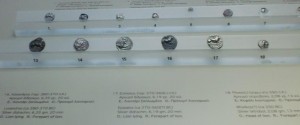
Modern times alas tend to make me sad. In 1976 the Central Bank of Cyprus issued commemorative coins for what is called on the Greek Cypriot side the Turkish invasion of Cyprus in 1974: it shows twice a mother and child, in front of a destroyed house and in front of a tent.   cypriot coinage

For the rest, the ‘other’ side of the island Cyprus does not exist in this exhibition; Cyprus is either the past, or Greek Cyprus. However, that past is shown so brilliantly here that I highly recommend this museum! The entrance, by the way, is free but worth a price.

Other blogs about museums with coins:
Money Museum Tunis
Money Museum Gaziantep

Elections in Turkey

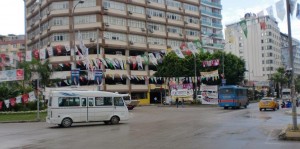
elections in turkey 0  Elections in Turkey are coming up and it is impossible to overlook them! I went to a trade mission in Adana and Mersin last week with the Dutch ambassador, his team and other entrepreneurs and we saw and heard the elections everywhere. Cars with loudspeakers shout out their messages: ‘Hey Adana’ and then the text of their campaign follows in a volume that forms an interruption for your conversation – just wait untill they passed to continue.
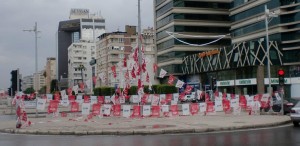
There are flags and banners everywhere, on the houses, over the street, over the river… think of a spot and the politicians did too.

Here some interesting pictures:
elections in turkey 2

CHP relatively modest on a roundabout;

elections in turkey 2

The ruling AK party: ‘Now I can go to university with my veil; they just talk, AK party acts‘;

elections in turkey 3

A big flag from the MHP party (grey wolves, a big party in Adana) and smaller – below the flag – a sign of the Saadet party: ‘not the European union but Islam union‘ (union is the same word as unity in Turkish);

elections in turkey 4

A big flag of the MHP over the road – busses and bigger cars can not go under it without touching the flag so it is damaged on the lower side but the effect is there I guess. In most countries this would be forbidden;

elections in turkey 5

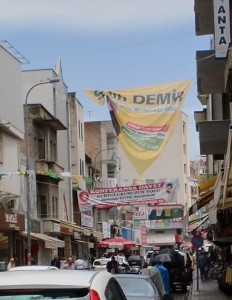
Not everybody is good in flags: the wind has frustrated the Salih Demir message here…

In the Netherlands it happens that people forget to vote. I don’t think that can happen here. Nevertheless it does not make politics more popular in Turkey than in the Netherlands; most people that I asked did not like the overall political presence.

Loin des hommes

loin des hommes  Loin des hommes

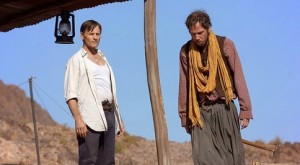
I was withholding my breath all the time while watching this movie: Loin des hommes. Algeria 1954, the colonial war or freedom war or however you want to call it, is about to begin. A teacher who’s school is in the middle of nowhere in the Atlas mountains gets involved. He is not looking for that but fate is looking for him. He ends up in several unexpected half war half peace situations. The mountains in the middle of nowhere are much more populated than you’d think: they are full of life, love and fights. Both the rebels and the French find their way over the invisible mountain paths. Will he have to give up his dream, to teach the children how to read? The teacher is also confronted with issues of culture, religion and identity. His parents were from Andalusia, he himself has always lived in Algeria and now others see him as French. There is so much actuality in this movie, it is not just a historical picture. And there is lots of deep warm friendship from man to man in this movie, too. The pictures are stunning. Go there, if you want to see something different!

You can find interesting books about Algeria in this blog and in this blog.

You might also like this blog: When inclusiveness met apartheid

Jewish museum Warsaw context

jewish museum warsaw context  Like most tourists I walked in the streets of Warsaw-Center and visited shops like a souvenirshop and a antiquitiesshop. Well, that was quite a surprise.
In the souvenirshop it was possible to buy magnets with symbols of Poland, like one finds magnets with canalhouses, tulips and wooden shoes in Amsterdam. One magnet was a yellow ‘Jewish’ star that mentioned ‘ghetto Warsaw’. I couldn’t believe my eyes, stood there thinking for some time considering whether I should buy it as proof.
jewish star warsaw  But I did not want to buy and thus encourage such souvenirs so I ended making a secret (and not well succeeded) photograph. I am sure that this yellow star would not be sold in the Netherlands but maybe this had a different meaning for the Polish people. I asked in the Jewish museum, showing the pictures but they reacted in a very neutral way, telling that they couldn’t read that it said ‘ghetto Warsaw’ which was true of course 🙂
In the antiquitiesshop it was possible to find all kind of symbols and pamphlets from the last century: communist and anti-communist posters, lots of stuff. I even found a poster in Dutch mentioning ‘Indonesië moet bevrijd worden’ showing an Indonesian guy in chains resisting against a Japanese soldier. As said it was in Dutch and not in Indonesian, this is a real historic thing as Indonesia was freed from the Japanese but then subject to a colonial war with the Netherlands, this poster maybe symbolized that already. The shop also offered Nazi objects. The picture on top and the one below were made secretly in this shop. Maybe it was not necessary to make them secretly, I didn’t know; as a Dutch person I had the feeling that it was a risk to take those pictures but maybe it wasn’t in the Polish context.  nazi stuff warsaw
All together this tourist street gave me many reflections about the context of the new and beautiful Jewish museum in Warsaw, Poland.

My other posts about the Jewish museum in Warsaw:
Jewish Museum Warsaw dilemmas
Jewish Museum Warsaw beauty

Jewish museum Warsaw dilemmas

jewish museum warsaw dilemmas Creating a completely new museum comes with lots of opportunities (that the Museum for the history of Jews in Poland discovered well) and also with dilemma’s. From my visit to this museum I remember two of them.
1. How do you present your history when it has got possibly unfavourable elements? Especially in the light of a history where others have tried many times to present your people as bad people and that this had fatal consequences. The first image of the Jews in Poland happens to be one that connects them to trade of slaves. It was by the way for the first time for me that I learned that the word ‘slave’ is actually connected to the Slavic people, that they were the slaves of the Middle Ages.
jewish museum warsaw6  The image shows Jews trading slaves and a bishop protesting against it; not because he was against slavery as such but because he was against the trade of Christians as slaves. Slavic people were already Christians by that time. Jews are recognizable with a 2-pointed hat. Could this image make actual prejudices increase? Is a scientific approach ‘this is the very first image and thus reality’ the correct one or should the museum be more careful and avoid a possibly bad image? The museum chose to show the 12nd century reality…
2. During war, the Polish were the only people to have an organizational structure to help Jews and this shows their heroic side. Opinions differ on the scale of effectiveness of the organisation. jewish museum warsaw7  How small or large should that part of Polish resistance take in the presentation of the 2nd world war part of the museum? You can imagine the discussions…
Most probably there were many more decisions to take that were a dilemma. What I like about this museum is that the makers are not afraid of decision making and also not of discussing the decisions made afterwards.They are transparent and they are accountable; a great sign of modernity that one can only appreciate!

Two other posts about the Jewish Museum in Warsaw:
Jewish Museum Warsaw context
Jewish Museum Warsaw beauty

Jewish museum Warsaw beauty

jewish museum warsaw beauty

28 October 2014 Warsaw could open the doors of the brandnew Museum of the History of Polish Jews and for certain, that museum is a beauty.
First of all it is a beauty from the point of view architecture. jewish museum warsaw beautyThe size of the museum is enormous which offers opportunities for spectacular projects like: telling the story of the Jews coming to Poland 1000 years ago with moving images on glass walls; rebuilding an old wooden synagogue with all its special paintings; and redesigning a street in a Warsaw Jewish neighbourhood in the 19th/20th century with all its cultural and political activities, see these 3 pictures for an impression.
jewish museum warsaw beauty  jewish museum warsaw beauty jewish museum warsaw beauty
Apart from the special projects you can find interactive expositions for all centuries (I loved the medieval ones), and learn a lot about Polish history in general, too. The way the partition of Poland among other countries in the 18th/19th century was symbolised by a big and empty throne, overlooked by foreign rulers is impressive. Of course many people like to have their picture taken at the throne so it is never empty for a long time. The museum allows this kind of jokes and activities which is very nice.
This is a museum that deserves your time, wandering from one room to another through 10 centuries of history. It is different from other museums: it is an impression, not an explanation. It is an atmosphere and a way to live the lifes the Jews in Poland lived since the Middle Ages. If you visit Warsaw, remember to go there!

My other posts about the Jewish Museum in Warsaw:
Jewish Museum Warsaw Context
Jewish Museum Warsaw Dilemmas

Warsaw Christmas lights (make the world a better place 3)

make the world a better place (3)  make the world a better place (3)  Warsaw Christmas lights make the world a better place. Some cities are good at special Chrismas lightning, some are less good. Amsterdam for example is not so good, not very creative in Christmas street lightning, but they also have the Amsterdam Light Festival (which is not the ordinary street lightning but specific enlightened art objects) and that is rather spectacular. Warsaw in Poland has very good designers for Christmas lights; look at the beautiful pictures. It gives class and style to the city and makes it a real joy to walk around:
  make the world a better place (3)  make the world a better place (3)Make the world a better place (3)
What amused me in Warsaw is that they also have this:
make the world a better place (3)     make the world a better place (3) Some wouldn’t call it class or style but the Polish citizens probably do. At least Warsaw is not afraid to combine these styles in the same street. And the children are happy with it!

Two other blogs in the theme ‘make the world a better place’
Lisbon pavements
Lisbon walking

Naziha’s spring – an outstanding IDFA documentary

naziha's spring  It was a coincidence that I went to an IDFA documentary, I never have / take time for things like that but in this case the maker of the documentary was the daughter of a friend with whom I participate in a Turkish litterature club – yes, all Turkish spoken so you understand I do not speak a lot, however I do read all the books (in Turkish) while not every participant does 🙂
I have to say that Gülsah Dogan presented an outstanding documentary that should be obliged learning material for any organisation involved in the problems of Amsterdam-West families. She has succeeded to make an inside picture about one of the (former) most problematic Dutch-Moroccan families Amsterdam-West has known. And anyone in the public can recognize and feel the characters, the conflicts, the existentialist problems that occur in this story. It is very moving – there were many tears – and the complexity of extreme family situations is revealed. This is a documentary that deserves a price and I hope it will win.
See http://www.idfa.nl/industry/tags/project.aspx?id=5273991f-70a3-431d-836f-264b6b41bce6, for more info and also times to visit next wednesday, thursday and saturday 26/27/29 November. Don’t miss this one! For me, it will still be on my mind for many days; it is really, really impressive!

Find another documentary made by Gülsah Dogan here: The hunt for my father

You might also like: Kurtulus son durak

Grandfathers, Jews and the impulse to act

grandfathers  It is one of the myths in our family history: my grandfather ‘saving’ a Jewish girl from a Nazi. It was in the 2nd World War. In villages, children from Jewish families lived as if they were part of the farmers’ family, trying to escape a certain death when the Nazis found out they were Jewish. A 14 or 15 year old ‘secretly’ Jewish girl, described as very beautiful, accidentilly fell in the village street and bumped her head against a stone right in front of the house where one of the Nazis in charge was temporarily located. He came out of the house, saw the beautiful girl and took her into the house to take care of her. All of the village worried, they were talking about it: what is he doing to that beautiful girl and also, most of all: what if he finds out that she is Jewish? They were extremely nervous!
The worries and talks in the village took a great part of the day, then at the end of the day my grandfather returned from work and heard about it. When he was told, he didn’t even think for a minute but just got angry and went to the house of the Nazi. Did he have a plan? I don’t think so. He did not talk, he did not ask questions, as he never did. He just had the impulse to act.
Did he save her? He didn’t I guess, everybody who was in this story agreed that the girl saved herself once the opening was given. As soon as my grandfather appeared at the doorstep, this ‘wounded’ girl stood up from the couch where she lied down, she ran to the door, embraced my grandfather and acted as if he was her father: ‘o dad, dad, please take me home’. The Nazi guy nodded and my grandfather took her ‘home’.

Summer 2014 we are living a period in Europe, and to my great great regret also in Amsterdam, where antisemitism is fully alive. And just like the village in the 2nd World War, everybody is talking about it. Everybody is ‘worrying’, like all of the village did in the War. But how many of us are acting?
What my grandfather did seems easy > he just went to the house. Anybody could have done that… but nobody did. So the real question is: why didn’t they do it? As the girl could save herself just upon the impulsive action of my grandfather.
I wonder about the conclusion of this story. Doing has more value, more effect than talking? Don’t spend time worrying, just act? Maybe that is true, also today…