Sderot: 15 seconds to run for your life

sderot

In Sderot, people have 15 seconds to run for their life when they hear an alarm because a rocket bomb will fall on the city. Before, this alarm was a siren. At the sound of the sirens immediately everybody in the 25.000 populated city started to run for a nearby concrete shelter that is safe. Nowadays the sirens have changed for a voice telling ‘code red’, because the life-threatening rockets fell so often at Sderot that it was difficult to bear the sound of the sirens all the time. During the last 10 years, 8.000 rockets hit Sderot…
Imagine if you had to run for a rocket once a day, just once a day: how would you feel? And how alert would you be, knowing that when the signal came, you had 15 seconds to reach a safe shelter? It means you’d have to know all the shelters in the places you regularly visit and that you’d always be aware of the distance between yourself and those shelters (as 30 seconds is too late and could mean death).
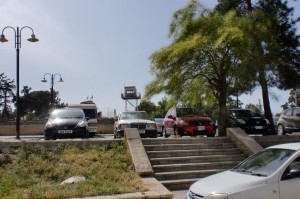
sderot Nevertheless, with 25.000 people, Sderot has a shopping center. The parking lot in front of this shopping center counts 3 concrete shelters so that everybody who comes to the center can be sure to find safety on time when he/she will be surprised by a rocket while shopping. They sell nice stuff and they are really surprised when you buy a shirt but don’t speak the national language; Sderot is not a town where tourists use to pass by….
It is almost impossible to understand how this mixture of normal life and rockets effects adults ànd children in Sderot. Especially children are traumatized but also adults can be stressed and quite affected by the continuous tension. Just try to run for your life 3 times a day and see what it does to your mood, your emotions, your productivity and your hope for the future. Then imagine that you live this situation hundreds of times a year. Maybe you cannot imagine. But it is real in Sderot… since many years.

Other blogs that might interest you:
Grandfathers, Jews, and the impulse to act
Security is your friend in Tel Aviv
Panagia Melandrina church – Northern Cyprus heritage (18)

panagia melandrina church

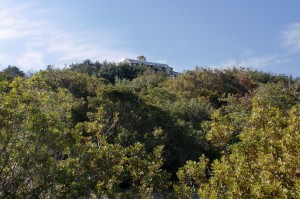
Finally we found the Panagia Melandrina church. We would not have managed without the help of an only-Turkish speaking but all-knowing worker at the Belediye (city hall) of Esentepe : friendly and enthusiast to help us out. After a search of several days for the Panagia Melandrina church, it was a joy to find it but a disappoinment to see it. UNDP and EU invested recently in ‘emergency measures’ to save this church (see UNDP-info Panagia Melandrina). I really wonder why they chose this church out of so many churches that could benefit from their time and effort.
melandrina church esentepe
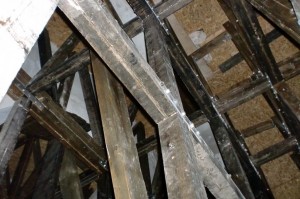
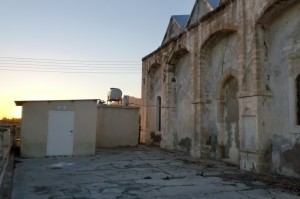
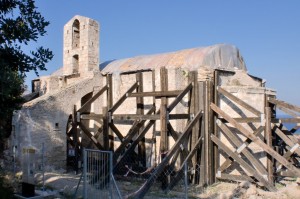
The Panagia Melandrina church lies in the middle of bushes and fields not far from the coast at the harbour location of Esentepe and it is in fact a ruin. It goes back to the 15th century and did have wall paintings as they were reported by an historian in 1896 but those have disappeared long ago. The monastery this church was part of, was active till around 1940. The efforts and investment of the UNDP and EU mean that the church is prevented from total disaster with countless wooden polls : see the photographs.
panagia melandrina church  panagia melandrina church
A roof was made and it is covered in plastic (partly torn already), also two of the outside ailes are covered in plastic. One wonders whether that does any good to the fragile remains, especially in humid times. Unless you are interested in sites like these anyway, there is not one reason I could think of to recommend to you a visit to the Panagia Melandrina church. There are a lot of other, more beautiful and less annoying antiquities to see in Cyprus.
Both the UNDP-findings and information on sites like this site indicate that the church may be built on an older temple or other remains. That is very interesting as this is also the area where some of the rather unknown Mezar Houses, the underground houses of the 10th century would have been found. In some cases, one can go for what one can see. In this case, I’d spend my time and investment on what could be underneath the surface…
melandrina church kibris

Another church near Esentepe: the Abadi church
And in Esentepe center: Agios Ambrosius church

Abadi church – Northern Cyprus heritage (17)

abadi church northern cyprus

We were looking for the Melendirina church – a church that was on an urgent list for reparation on UNDP initiative in 2012 – when we came across the Abadi church. At first we did not know at all what kind of church it was; there is absolutely a lack of information about the churches in the Esentepe / Agios Ambrosius area. Any information you look for leads you to the Antiphonitis monastery – see our blogs Panagia Eleousa church and Agios Mamas church for the rest, churches seem to be considered uninteresting or non-existent. That is such a pity as we showed in the blogs 14, 15 and 16 of this Northern Cyprus heritage series that there is a lot to be discovered. Esentepe is not a touristic area which might be the reason why it is so difficult to find out more about the specific sites.
It was not clear how to get to the Abadi church when we saw it, driving our way through the mountain forests above Esentepe; so we ended up by just parking the car among the trees and walked our way up to the mountain. And there it appeared, the Abadi chapel, in all its beauty. Alas it was closed so we could not see the inside. The doors of the chapel looked quite new which gave us (born from experience) the idea that there was nothing inside any more and that doors were placed recently to protect the last bits and pieces. Please try to enter one day and prove us wrong.
abadi church northern cyprus  abadi church northern cyprus
As we had no clue about the chapel, its name or origin, we concluded from the surroundings that it had had a courtyard with beautiful trees, so it was an important center, some time, some day. Later we read on internet that it had been a monastery that was ruined and  that a small church was built to replace the institute. So this is some kind of hidden secret in the middle of the forest on the hills above Esentepe / Agios Ambrosius


Panagia Eleousa church – Northern Cyprus heritage (16)

panagia eleousa2


Panagia Eleousa church in Tirmen/Trypimeni is another church that was turned into a mosque after the Turkish army took hold of Northern Cyprus in 1974. The church seems to be in a reasonable estate, just like the village itself that is not the wealthiest village to be found in the area either. The village lies right on the south side of the Pentadaktylos mountain range and overviews the Mesaoria plain that separates the Troodos mountains on the Greek side from the Pentadaktylos mountains on the Turkish side. Apparently the Mesaoria was a sea in very old times; so the symbolic separation was already there in history…
panagia eleousa church  panagia eleousa church
The only information that I could find about the Panagia Eleousa church is that it was built in 1900. I was wondering about the tower, it seems to be a different style than the church, made from different materials, attached to the church externally from the side and put right in front of an opening fence; all this suggests that it was added later. The Panagia Eleousa church is more beautiful without it. panagia eleousa church clock tower
The clocks from the church tower are missing. For the use of the mosque some small details were added like cleaning rooms and they are quite ugly.
If you have more info about the Panagia Eleousa church, feel free to comment. In this Northern Cyprus heritage series there are other blogs showing churches that were turned into mosques after 1974, see Agios Ambrosius church and Agios Mamas church.

Agios Mamas church – Northern Cyprus heritage (15)

agios mamas church bahceli


Agios Mamas church
In Bahceli (Kalograia), about 20 miles east from Girne, there is another church that was turned into a mosque at an early stage, already in 1975 so very short after the Turkish army took hold of the Northern part of Cyprus. It is the Agios Mamas church Bahceli, named after Saint Mamas who lived in the 3rd century and seemed to be quite brave – his best companion being a lion. Read some more about him at http://orthodoxwiki.org/Mamas_of_Caesarea .
From the outside the church seems to be in a reasonable stage – note that the village itself looks rather poor. Only the clock tower is at riskagios mamas church bahceli as the picture here shows. The clock itself is still there but seems to have fallen down and rest on the wall sides.
We have not seen the inside. I could not find a lot of information about this church at all. Those who know more (facts), feel welcome to comment.
Agios Mamas is not the only church in this region transformed into a mosque, read also Agios Ambrosius church , another blog about Tirmen/Trypimeni will follow. You can find it here: Panagia Eleousa church
agios mamas church bahceli    agios mamas church bahceli

Agios Ambrosius church – Northern Cyprus heritage (14)

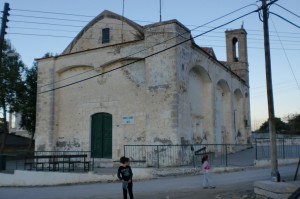
agios ambrosius church northern cyprus In Esentepe, a small town about 20 miles to the east of Girne, we find the Agios Ambrosius church that has been transformed into a mosque in 1978 already; this happened in more villages in this part of Northern Cyprus (other blogs will follow). Agios=Saint Ambrosius was a very influential bishop of Milan and a Doctor of the Church in the 4th century. The Agios Ambrosius church was built in 1867 out of yellow stones and characterizes very much the Byzantium architecture. It seems to be in quite a good state (we did not see the interior but the exterior looks fine) and in general inhabitants take care of the city center where it stands.
Actually with the peace talks between North and South Cyprus making progress, the question is raised what will happen to churches that were turned into a mosque. Time will tell… first bring the peace talks to a good end, then solve this too.     esentepe-ambrosius  esentepe-ambrosius2  esentepe-ambrosius3

Other churches near Esentepe:
Abadi church
Panagia Melandrina church

Taxi Teheran

taxi teheran  Taxi Teheran

How to make a movie that is only playing in a taxi and does not bore any minute? Taxi Teheran is a succesfull try-out of that concept although not by free choice alone. Jafar Panahi, maker of the movie and also its main character has a history of struggling with censure and oppression in his country Iran. He is not allowed to make movies during 20 years and this movie, Taxi Teheran, was made secretly and smuggled out of the country.
The movie is very funny with many surprising moments, and it has a groundtune of sadness underneath. As such, it is very Iranian: Iranians usually are well developed, social, bright and full of life, they know how to make the best out of difficult circumstances. But that does not mean that they do not feel the difficult circumstances, especially the oppression.
In Taxi Teheran we see a wonderful mix of people entering and leaving Jafar Panahi’s taxi. Even the concept ‘taxi’ in Teheran is different from other countries and that in itself creates unexpected situations. Taxi Teheran shows a lot of interesting interaction between a variety of inhabitants of Teheran. And it gives some great insights in the well developed double face of Iran, in survival and creativity against the odds.

Other movies I wrote blogs about and that you might like:
Banana pancakes and the childres of the sticky rice
Visages villages

Agios Trias Basilica – Northern Cyprus heritage (13)

Northern Cyprus Heritage - Agios Trias Basilica 0

Agios Trias Basilica

5th/6th century rests of the Agios Trias Basilica are found on the peninsula of the Northern Cypriot Karpaz close to the village of Sipahi which means: in the middle of nowhere. We were the only visitors but there was a most friendly guard who was happy to sell us a ticket for 5 TL, at that moment € 1,90 (it was before the 2015 elections, after which the Turkish lira devaluated). So the entrance price should not stop you from visiting Agios Trias Basilica and moreover the mosaics are very much worth a visit, they are amazing!
Northern Cyprus Heritage - Agios Trias Basilica 1  Northern Cyprus Heritage - Agios Trias Basilica 2  Northern Cyprus Heritage - Agios Trias Basilica 3  Northern Cyprus Heritage - Agios Trias Basilica 4  Northern Cyprus Heritage - Agios Trias Basilica5  Northern Cyprus Heritage - Agios Trias Basilica6
A great article with lots of information about this site can be found here: http://allansartworlds.sites.ucsc.edu/wp-content/uploads/sites/154/2015/03/Langdale-Basilica-of-Agias-Trias.pdf. This article published in 2009 talks about ‘lack of proper maintenance (page 2). Things have only got worse since that time. The unique mosaics lie there completely unprotected and this is not all… (reliable) rumour goes that the mosaics are regularly ‘cleaned’ with a high pressure washer.
In an earlier blog I wrote that the Greeks consider the Turks as barbarians – for the way they deal with their heritage and that sometimes they are proven right in that opinion. This is one of those times, that they are proven right. I thought I’d faint when I heard about the high pressure washer…
Anyway this monument Agios Trias Basilica is still extremely beautiful with its unique mosaics so I’d hardly recommend a visit. Positive thinking: it might be one of the only moments you can actually and freely walk over 5th/6th century mosaics and live the feelings of people who did the same many centuries ago.

Blogs about Mosaic Museums:
Vesunna Museum Périgueux France
Bardo Museum Tunis, Tunisia
Zeugma Museum Gaziantep, Turkey

Green Line Nicosia – Cyprus

green line nicosia saray hotel 4   nicosia green line saray hotel 5
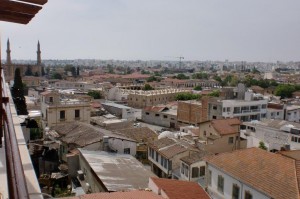
Look at the Green Line Nicosia – Cyprus from above in these pictures and you can easily see 2 cities here: the Turkish one, in front and the Greek one, further away.nicosia green line UN post Nicosia Invisible here, inbetween the two city parts lies the Green Line, a 100 meter large strip where the UN rules since 40 years (!) to separate the Greek Cypriots from the Turkish Cypriots… Easy to understand how bored the UN-soldiers are here, they just ride around in expensive UN-cars as there is nothing else to do. The fighting has stopped long ago and the frontier is even ‘open’ since 2003 at three points at the Green Line Nicosia. Parties make small steps forward that symbolize progress like the abolishment of giving stamps every time a person crosses the transit point; this step was the first result of the new peace negotiations that started 2 weeks ago. It lead to quite some confusion especially at the Turkish side: the protocol had to change but Turkish officials love stamps – clearly that was really a thing to give up for them 🙂 Anyway the international community was investing here at least 30 years in vain, paying for useless UN-presence, boycoting the North / Turkish side without any result. For how long will we continue to do so? And why?
Nnicosia green line greek soil versus turkish sideinicosia green line turkish soil versus greek sidecosia could be a beautiful and flourishing city but it is not because it has no heart but a Green Line, a real wall in the middle of it: see the pictures, where we walk on the Greek side with theTurkish Cypriot and Turkish flags on the old city walls, and the walk on the Turkish side limited by a sudden wall to stop us going to the Greek side: no entrance, no photographs allowed either by the way.
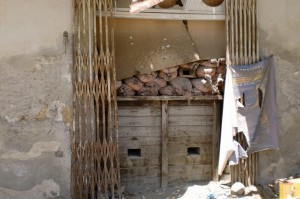
I found the transit point at Ledra Palace the most sad one I have seen so far, although there are several peace seeking initiatives in the buildings there (and also the German Goethe Institut as if nothing happened, very funny). This transit point is at the Greek side surrounded by despair, no investment, no renovation, and even 40 year old remains of fighting (kept there deliberately?):
nicosia green line house at ledra palace  nicosia green line remains of fighting close to ledra palace
Coming from the city of Amsterdam where we love to restore houses and to let original beauty come out at the max, I have to say my hands were itching to take on the job. But well, there is certainly a reason for the non-investment and Nicosia will stay a city without a heart untill the political problems are solved – I hope: soon!

What to do in Nicosia as a tourist? Go to the Museum of the history of Cypriot coinage.

Want to read political stuff? Read about the so-called Freedom Day in Northern Cyprus

Elections in Turkey

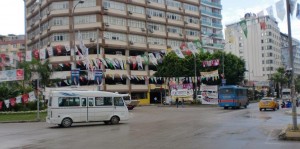
elections in turkey 0  Elections in Turkey are coming up and it is impossible to overlook them! I went to a trade mission in Adana and Mersin last week with the Dutch ambassador, his team and other entrepreneurs and we saw and heard the elections everywhere. Cars with loudspeakers shout out their messages: ‘Hey Adana’ and then the text of their campaign follows in a volume that forms an interruption for your conversation – just wait untill they passed to continue.
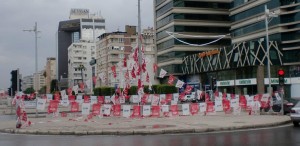
There are flags and banners everywhere, on the houses, over the street, over the river… think of a spot and the politicians did too.

Here some interesting pictures:
elections in turkey 2

CHP relatively modest on a roundabout;

elections in turkey 2

The ruling AK party: ‘Now I can go to university with my veil; they just talk, AK party acts‘;

elections in turkey 3

A big flag from the MHP party (grey wolves, a big party in Adana) and smaller – below the flag – a sign of the Saadet party: ‘not the European union but Islam union‘ (union is the same word as unity in Turkish);

elections in turkey 4

A big flag of the MHP over the road – busses and bigger cars can not go under it without touching the flag so it is damaged on the lower side but the effect is there I guess. In most countries this would be forbidden;

elections in turkey 5

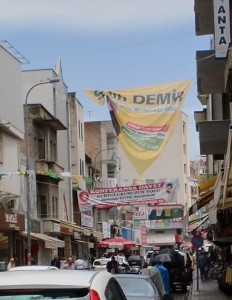
Not everybody is good in flags: the wind has frustrated the Salih Demir message here…

In the Netherlands it happens that people forget to vote. I don’t think that can happen here. Nevertheless it does not make politics more popular in Turkey than in the Netherlands; most people that I asked did not like the overall political presence.

Istanbul: mysterious tickets after Süleymaniye Mosque donation


Süleymaniye Mosque

On leaving the beautiful Süleymaniye Mosque (also known as the Blue Mosque) I gave a donation to a guy sitting at the exit of the Mosque with a sign ‘donations for the Mosque’. As the entrance was free and usually the maintenance of this kind of buildings is enormous in costs, it seemed reasonable to have some contribution. I gave money and got a few blue tickets in return for that. I looked at them and thought, why do I get this kind of tickets? I gave a donation, but what is this for?
As my brains couldn’t find a solution, I started to think the Dutch way. This must be a proof for tax administration that a donation was made, I thought. In the Netherlands this exists; for income that is spent in gifts to good aims, citizens don’t need to pay taxes. But you must be able to proof that you gave away that money. I suggested the Turks might have the same system and that the tickets I got at the Süleymaniye Mosque served to prove to Turkish taxes that this money was really spent as a gift. But I also know that perspectives can be coloured too much by national perspective. The reason why I got the tickets could be completely different.
So in the restaurant, close to Süleymaniye, where we had dinner after visiting the Mosque, I showed my newly acquired tickets to the staff and asked them for the meaning of them. The staff was very surprised about it: ‘we have never seen these tickets before’. They started to question me ‘the Mosque is free to visit, why did you give them money?’.  I tried to explain to them the idea, or should I say idealism, of donations but my table company destroyed it all by saying ‘she wanted to feel good about herself’, making everybody burst out in laughter as if I were the kind of fool that was hardly seen in this part of Istanbul.
The restaurant staff explained to me ‘the government takes care of the Mosque, they don’t need your money’. Hey, I don’t give up that easily so I responded in an utmost surprised way ‘ah, I thought Turkey has a separation of state and religion’. ‘Well yes’, they replied, ‘the state doesn’t pay any money but local government does, the city of Istanbul is taking care of the Mosque’. I thought that the separation of state and religion also involved local government as well as national government but they thought that local was completely different from national and showed surprise that the City of Amsterdam is not giving money to churches or mosques ‘Istanbul is very social but Amsterdam is not’.
Soon enough, we started to talk Turkish instead of English and we jumped from the way Christians were treated in the South-East of Turkey to the way Muslems were treated in Greece and Bulgaria. I got a bit upset and so did they, and they had the superiority of language, meaningful in situations like the moment where I said that the monasteries in the North (güney) had a hard time under Turkish government when they declared there were no monasteries in the North – like I usually do, I mixed the words South and North (kuzey versus güney); a problem of mastering a language that weakened my arguments because they wouldn’t notice that I was not telling an ‘untruth’ but making a language mistake.
We didn’t really find a solution for Muslems in Greece and Bulgaria or for Christians in South East Turkey but we had a drink together to close the discussion. The only problem that lasts now is that my question about the tickets was left unanswered: why does a tourist who gives a donation to the Süleymaniye Mosque get tickets showing the period, the amount and the purpose of the donation? If you, reader, know the answer, please send me a message because I really like to know after all…

Other blogs you might like:
Istanbul and souvenirs with a religious component
Agios Nikolaos
Istanbul street cats

Istanbul religious souvenirs

Istanbul religious souvenirs

Changes can sometimes be perceived in small signs that function as a symbol for deeper lying norms and values. One of those signs in Istanbul is the way souvenir shops deal with presents that have a religious component. When I was here twenty years ago, the presents with different religious background were thoroughly separated from each other. For example in the jewelry market, jewelry with the ‘bismallah’ sign were sold in shops with a muslem owner, golden crosses were sold in shops with a christian owner. In that time there was no mixed collection of presents with religious component to be found at the same shop; absolutely nowhere!
This is something that has really changed now. In many shops it is possible to find articles with islamic, christian and jewish meaning all together not just in the same shop, but also on the same shelve. For someone like me who missed 20 years of Istanbul development, it feels like a radical change. I asked some questions about it in one souvenir shop and the workers there kindly explained to me that they believe in and respect all the prophets. I tried to explain them how this was in the years ’70, ’80, even begin ’90 but they kept telling me how they feel about it now. They couldn’t explain history to me, why it was different before and why it changed. They had Maria and Jesus hanging in their shop next to islamic holy artefacts, see the picture above, and considered that as normal.
I cannot analyze this yet, it would need a more indept insight but as said I have seen this mixture in many shops in Istanbul city already. These are small signs for what could be a more fundamental change. My first and overall impression is that the selfconfidence of the Turks has increased a lot in daily life, and tolerance often comes with selfconfidence. Another way of looking at it could be that the Christian minorities form no more threat whatsoever to the Turks which allows a different attitude. Finally, it is also possible to look at this businesswise. The Turks were always good in customer service, eager to help customers out, create strong relationships and earn some money; maybe they have just added these new products to their buckets…

Other interesting blogs:
Minorities in Gaziantep
Istanbul: mysterious tickets
Mikve Israel-Immanuel synagogue
Ramallah: Jews removing Christians from Middle East