

Everybody in Gaziantep told me to go to the War Museum (Savas müzesi). ‘I went already to the castle‘, was my answer – the description of the independance war there is detailed and could not be improved (see my blog about that visit here). ‘But the War Museum is different’, they claimed. I did not go but in the end I happened to drink a tea with a guy who appeared to be a guard and he did not even ask me whether I wanted to go. ‘I have to show you’. And there we went. Well it was a happy surprise. 
The War Museum Gaziantep situates mainly in the underground caves that were used by the Turkish resistance during the Independance War. You can experience there what life looked like for them. They made everything themselves, food, olive oil, soap, even rifles. The guy who made the rifles is shown in the picture on top and here on the sign.
 Other ‘puppets’ make clear how women and even children were filling the bullets.
The story of the sewer canals is also interesting: they were used to move underground through the city without the enemy noticing anything. Knowing one’s own field has always been a decisive element in man-to-man battles. A few (entrances to the) canals can be seen on the spot. The wounds and the suffering of the heroes have been  made quite explicit in several puppets. The picture here shows the underground hospital and you can see the blood run.
 Most of all however, I liked the rattles. When the French started to shoot and the Turks didn’t have enough ammunition, they would play the rattles to imitate gunfire. I got a demonstration from my guard, it was brilliant – you’d really think that a well equiped army is responding to your gunfire…
Those who said `the War Museum is different` were right, it is different and it is adding some important information to what the Gaziantep castle presents. Daily life in the caves is absolutely interesting to see. And the result is also that I will never forget how brave (`Gazi`) the inhabitants of Antep are, and will be in any war in the future. The lesson is transmitted thoroughly both to visitors and to the population.

“Every Turkish city, every town and the smallest Turkish village can accept the people of Gaziantep as examples of heroism”
Another blog about this subject: http://turkishtravelblog.com/gaziantep-war-museum/
Other interesting places to visit in Gaziantep:
Medusa Glass museum
Money museum Gaziantep
Zoo Gaziantep

 It is nice and well enough restaured for a good impression what the castle was like in the old days.
 Lots of kids are visiting the castle to learn about the war but also many Turks from Gaziantep and elsewhere show indepth interest in the exposition.
 More on this subject:
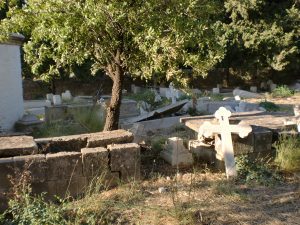 (the Turkish side), the Greek graveyards may have been destroyed deliberately as they are all in a devastating state. The situation for Turkish cemetaries in the South of Cyprus (the Greek side) is different, he says. This raises questions about why this is the case and M. Thorsten Kruse comes – roughly – to conclusions as I formulated in


 give up hope for Arab leadership and think that the French offered more. Boudjedra shows how cruel the French regime has been in Algeria; even though that did not improve after the Algerian independence, that does not mean that he feels nostalgia for the French colonial times in Algeria, on the contrary: he is rather inclined to conclude that cruelty and barbarity is part of human history, in whatever shape or nationality.
 Mijn ontdekkingstocht naar diversiteit & inclusie in Arabische landen gaat verder, ditmaal via diversiteit in Marokko en Tunesië. Na de start in Jordanië (
 In Marokko werd ik daarbij nog verrast door de grote persoonlijke warmte van de deelnemers. Hard werken ging er gemakkelijk samen met positieve emotionaliteit, Een deelneemster gaf me na afloop haar prachtige oorbellen mee, als aandenken namens de hele groep.
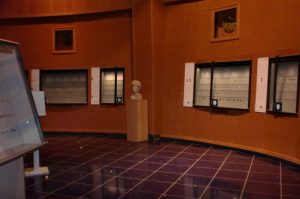
 Already in the first century of islamic era, coins were made with Qu’ran inscriptions and this museum shows a good quantity of them (a lot in gold, part of the attractiveness of course).

 And it presents plenty of memorial coins, and coins of special sites where I found Amsterdam among them.
 Last but not least: the library they have offers books in 5 or 6 languages, not just about coinage but also about history and art of the region. It is an excellent collection for those who want to study and it seems to be an undiscovered place: you can sit there in complete tranquillity, surrounded by friendly workers who are happy to welcome anyone interested in their cultural heritage.


 Ramallah is a lively and kind city. During a short trip through the city, at least five people said spontaneaously ‘welcome’ to me. Isn’t that nice? I love tourists in Amsterdam (except when they walk on the biking paths) but I never tell them ‘welcome’; maybe that is a good thing to learn from the Palestinians here! It makes life more beautiful…
 Ramallah is also a contradictory town where you can buy the biography of Hillary Clinton at several places as well as Mein Kampf from Hitler, both in Arabic. I met with some police officers who were nice and accepted to have their photograph taken; another spontaneous move I guess, in this region where officials usually say no.