
A school  serves as Şehitler Müzesi, the Martyr’s Museum for Murataga, Sandallar and Atlilar where massacres took place in 1974. I passed this museum by surprise, on my way from the monument and mass grave of Murataga and Sandallar to the one in Atlilar. I didn’t even know there was such a thing as a museum, maybe it is of rather recent date. It is quite small and somehow one of the saddest places I have ever been to.
The school lies in a kind of courtyard where there is enough place to put your car. I was the only visitor that day and the day before me there was also only 1 visitor. As you can see in the picture, there are information boards on the left (in Turkish) and the right (in English) along the path to the Şehitler Müzesi and they are really good. Of course the perspective of the information is the Turkish Cypriot perspective; this is not the place for an interesting two-sided history. If you go to the Şehitler Müzesi, you look through the eyes of the locals of Murataga, Sandallar and Atlilar. As their perceptions are rarely found in the news or other sources of information, I found it very enrichening for a better understanding of why things are felt the way they are in Northern Cyprus.
The school of Murataga-Sandallar was not very old. Until 1958, children used to go to the mixed school of Alaniçi (in Greek: Pigi Peristerona).  There had always been some pressure on the Turkish Cypriot children but the heavy troubles of 1958 chased all Turkish Cypriot children away and forced the last Turkish Cypriot inhabitants of Pigi Peristerona to leave and move to the smaller village of Murataga (in Greek: Maratha). Murataga welcomed the ‘refugees’ and built houses for them. At that time also a school and a mosque were made. Who could imagine that on August 14, 1974, 29 children (their names are in the picture) of that school would be killed, bulldozered and buried in mass graves?
 However, what affected me most, was the guide of the museum himself… At the time of the massacre, most Turkish Cypriot men were in camps where the Greek Cypriots kept them as prisoner; some young men like himself had already gone to places where the fights took place, in his case Famagusta (in Turkish: Gazimagusa). While t
 hey were absent, the women, the children and the elderly were murdered. The men who survived and returned to Murataga, Sandallar and Atlilar, found out that they lost almost everybody. For the museum guide this meant: his mother, his five sisters and his brother – you can see them in the lower row on the picture to the right – and his aunt and her seven children. Only his father who was a prisoner at the time of the massacre, survived.
Now, this man is every day in a museum that – compared to museums in Amsterdam where I live – has hardly any visitors and he stays in that school alone facing the pictures of his murdered family members and all the other victims every day…
The museum has a video (Turkish only) about the event but I didn’t watch it.
If you are interested in the history of Cyprus, I do recommend the Şehitler Müzesi even though it might cover you with a blanket of sadness; it will highly contribute to your understanding of the Turkish Cypriot soul, and why they put safety first in all the negotiations with the Greek Cypriots.
The Şehitler Müzesi has published a book under the title: 1955 – 1974 Step by Step Genocide – Murataga – Atlilar – Sandallar. I bought the book and will tell you more about it in my next blog.


 difficult to identity. In a recent project to find the many people that were ‘lost’ in the 1963-1974 period – both Greek and Turkish Cypriots, see also
  I found this place thanks to the indication of locals in Alaniçi after a surprising visit to the churches in that village (see my
  I went there. It has a marble monument next to the spot of the former mass grave and what really irritated me, an information board that has fallen to the ground and is left there, neglected. On lifting it, the information was visible and no different from the information at the place of the tombs. But however, either you want to give that information at two spots, then take good care of it, or you just remove it from the second spot. A mass grave is not a place to be so disrespectful, that is really disturbing…
 It was a traumatic event where many inhabitants from both sides had to leave not just their possessions but also the neighbourhoods and the lands they deeply loved. Greek Cypriots have been mourning loud and clear ever since, asking back their belongings and the lands of their ancestors. The Turkish Cypriots have been mourning too, about a lost past. As their safety was at stake in the period of the conflict, they had no interest to go back to where they came from after 1974. They helt no political lobby and just mourned in silence. See also my blog about
  When I asked about the graffiti of EOKA on the churches, the locals became emotional and did not want to talk any more about this subject. It was only then that I realized that the places of the 1974 massmurders were here; I always thought they were close to Lefkosa (Nicosia) and had been looking without ever finding them.
  The locals were happy to show me the road to those villages: Murataga, Sandallar and Atlilar; I think they were just happy that going there meant I would leave them alone. There was no anger or bitterness in their avoidance: just an immense grief. They would not express that in words. It was like a cloud that had covered them – and me, by the way.
 The road went through fields where there seemed to be absolutely nothing. And then, suddenly, it was there. A monument, a graveyard that looked quite new, a short photo exhibition, a sign pointing at the location of a mass grave. It is difficult to imagine that there can be so much hatred in the wideness and largeness of empty fields… but it had been there. I stepped out of the car to take a closer look into the cruel past of Cyprus (to be continued in


 The first church is (most probably) named Agia Marina.
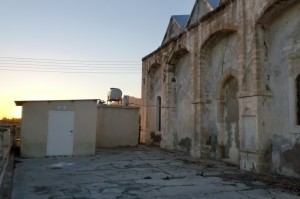
  It is beautiful but in bad shape. The doors are closed but entering through a large window is possible. Pigeons live there in large quantities so the dirt is obvious. Most of the church’s interior is destroyed; see for example the marble altar in pieces in front of the church choir. It is possible to go upstairs to the first floor; the stairs are intact but I didn’t risk to walk on the wooden balcony though. What surprised me however, was to find the words EOKA and ENOSIS on the outer walls of the church, along with other Greek writings I could not decipher at that moment. I was surprised because during my multiple visits to Greek churches in the North all over the Island I never found these on church walls: just once, on the wall of a churchyard at
  Next, easy to find when you just follow the main road through the village,
  was the enormous Agios Anastasios church, built in 1953. It is open and also the first floor can be visited. There is still a good impression of what this church was meant to be. The state of the concrete and several details does not look attractive at this moment but my opinion can be biased because I don’t like this kind of new churches.
 The old monastery church that stands nearby is also open because a door is missing. There is nothing interesting left at the interior.
  I could not find any history about this church, whether and how it was used after the new church opened in 1953. A short look down the stairs lead to a small cellar under the church. Some buildings next to the church could have been sleeping places for monks or stockrooms. Nothing really left there either.
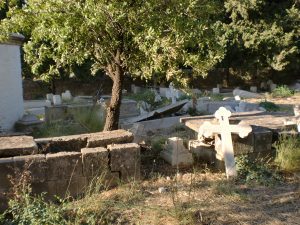 (the Turkish side), the Greek graveyards may have been destroyed deliberately as they are all in a devastating state. The situation for Turkish cemetaries in the South of Cyprus (the Greek side) is different, he says. This raises questions about why this is the case and M. Thorsten Kruse comes – roughly – to conclusions as I formulated in


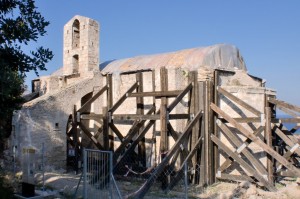

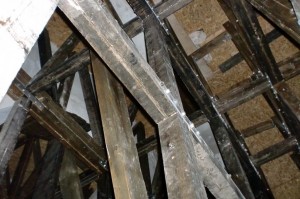



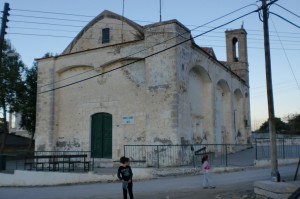
 as the picture here shows. The clock itself is still there but seems to have fallen down and rest on the wall sides.

 In
In 


