

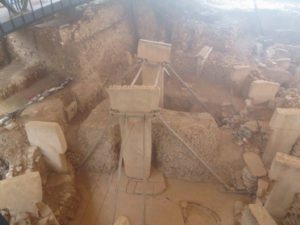
Archaeological Museum Şanlıurfa is unique, as it contains the artefacts found in Göbeklitepe, the oldest temple complex ever found (for example way older than the pyramids in Egypt). It is a very rich museum simply because the region is so rich in archaeological findings. All objects shown are ‘local’ and absolutely unique. Moreover, good efforts were made to make historical moments come alive for the visitor. Signs are both in Turkish and English and they offer excellent information.
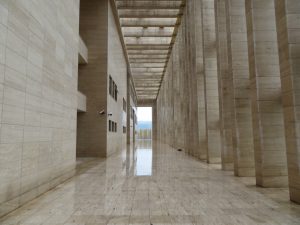
Archaeological Museum Şanlıurfa in its actual form is brand new (opened in 2015). The museum is large and its space gives a relaxed feeling to visitors. It is almost as if they left lots of space for new objects to come, which will certainly be the case. Unfortunately in this region, several dams were built covering the world’s oldest sites in water (Atatürk Dam, Birecik Dam, Kargamış Dam). There is a clear conflict of interest between conservation of archaeological areas and modern development issues – in that conflict, under actual Turkish politics modern development comes out as the winner. ‘Rescue excavations’ have been made regularly, often under supervision of the Archaeological Museum Şanlıurfa. Artefacts and other findings that could be ‘rescued’ are shown in this museum. All the rest is gone now, maybe to reappear one day from under the water, maybe lost for good.

A ticket for the Archaeological Museum
Şanlıurfa also gives entrance to the Mosaic Museum next to it and vice versa. Anyway you won’t avoid these museums for the price (only € 2,- when I visited December 2018). I will show you some highlights here about things I liked; be aware there is a lot more to see! A visit absolutely recommended…

The oldest statue in the world, found in Urfa center. I thought I saw the oldest statue in Amman Archaeological Museum but this one is older indeed. The figure has a clear expression, maybe because of the black obsidian eyes. At the bottom, it is smaller; most probably the was put into a hole in for example the rocks (like in Sogmatar) to stand upright.

A unique, astonishing picture of a woman giving birth, 10.000 years ago. It was found in Göbeklitepe. Other findings and the temple exposition of that site are mentioned in my blog about Göbeklitepe, a reason in itself to visit this museum.
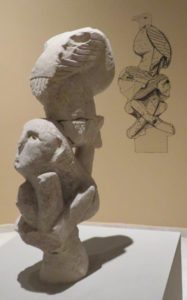
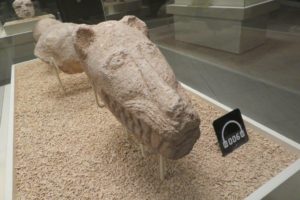
Statues that mix human heads and animals, found in Nevali Ҫori, one of the sites now lost in the water. I found it astonishing that 10.000 years ago, humans were able to make statues like this.

Clay nails to form mosaic pictures. You see here the nails, and an example of how pictures were made by putting them in the wall.

They could be painted in different colors after that, too. They are from the Uruk culture, 4th milennium BC.

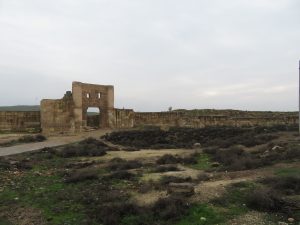
Pottery from the Bronze Age, depicting a gate / tower. I saw this after my visit to Harran and I stood there in surprise: doesn’t this pottery resemble the Aleppo Gate I went through? I told myself the gate in Harran is more recent in age but still….

Lovely Bronze Age terracotta. Nice animals, and a stamp seal.

Never saw such a stamp seal before. The museum has different types.
Statue with Syriac inscriptions, Roman age. Syriac was the common language during a long time in Şanlıurfa, called Edessa in biblical and Byzantine times. The inscription says: “This sculpture is Şamașyahb’s son Lișammaș. His brother, Barnay, made it for him. Who destroys this, will be punished by [the god] Sin”.
























 Bilqiss is about regrets and hope for the chance to be the one you should have been. Living in a burqa is more than just having some inconvenient clothing; it is the expression of a patriarchal society where women live within the boundaries men grant them. Individual men have the right to totally suffocate the women they live with. You might be bored when I write it like this but reading Bilqiss will not bore you.
 Archaeological Museum Haarlem
 ople in that period. A woman working with the police worked on the basis of his bones to bring him ‘back to life’, for us living in the 21st century to identify with and see who made all the things that we find in excavations.
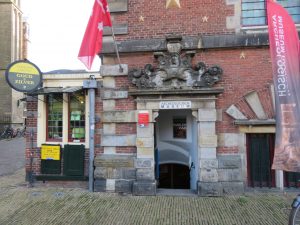 . I got all this information from a volunteer who started explaining stuff to me without asking, calmly and politely and very knowledgeable. Thanks to volunteers the Archaeological Museum Haarlem can open five times a week. It is not very big: the size of one room. Both history story lines and the objects are very well presented. Creative methods are used to get stories across and it is very child-friendly. History is in Dutch only – object names are also in English. I am sure a volunteer will be helpful for English speaking visitors. I show here some objects I particularly liked, but there are many more special pieces:


 Container to collect dripping fat:
 Battle for Haarlem:

 and an economist. Since he started writing, he won many prices: many French ones, but also this
  anish?)
 Rouiba, once the prosperous industrial suburb of Algiers, is revealed as if you walked there yourself. Le serment des barbares does not end well and that is a logical consequence of the story. When religious fanatism, anger, madness and greed reign, there is no hope.
 In English: The German Mujahid
 ’Abistan, a world that is stable and closed in itself. Religion is dominant in every aspect of daily life. To instaur the system, the past where this religion was not dominant has to be forgotten and free thought is seen as a major threat to the system. So there are many ways to check and control what people think and do. Every answer is given to the people. There is no reason for them to ask questions. However the book’s main character Ati got somehow ‘enlightened’ during a sick leave where he had time to think and to meet different people than usual. From that moment he is in constant danger.