

Traveling in Şanlıurfa is a great idea but not easy. Here I give you some tips. Do not worry about food or pickpockets. Buses and taxis make your transport easy if you do not want to walk. Your problems are different in this conservative area and mainly concern ‘the rules’ and personal safety.

Conservatism and safety
Traveling in Şanlıurfa is traveling in a conservative place. The general norm here is orthodox Islam and it is known that radical elements are also here. Be aware that the center of the ISIS-calliphate was next to the province of Şanlıurfa (so-called capital Raqqa only 70 kilometers away). A friend of mine who visited 2 months before me noticed quite some Dutch license plates on cars (‘Syrië-gangers’), radicals who had fought in Syria and passed the border to be more safe in Turkey as they were loosing the fight in Syria. I myself didn’t see them by the way. However, conservatism can be felt in many aspects.

I got loads of questions as a woman traveling alone. Locals can get quite irritated because they feel you cross the line – you break the rules just by doing so. On the other hand, comments can be tackled with friendliness and compliments; locals are sensitive to that. Be aware that you can not change the world. Do not go into discussions you can’t win and that might bring you into safety problems. Confirm what is OK in the culture to support your safety.
For example I was in a dolmuș-bus and after the other passengers had left, the driver started to criticize me for traveling alone as a woman, and how that problem should be solved now. I responded that there was no problem because Turkish hospitality is unbelievably wonderful and that everybody is willing to help me as a guest. He immediately confirmed my view, yes, Turkish hospitality was beyond what any country had to offer (Turkish nationalism is always strong 😊). Then he frowned, I think he understood that after his praise of Turkish hospitality, he couldn’t go back to the subject of me-alone being a problem.

Conservatism means people want to play by the rules, and they do not think about the meaning of rules. They can not discuss them. For example at Göbeklitepe I first went up the hill with my ticket to see the temples but I came down because the weather was very bad. I entered the building downstairs for a coffee and audiovisual show. After an hour, I decided to try again and they wanted me to buy another ticket because I went up already. Note that all were shivering, and they knew I did not go on the temple hill itself. The keyword here is patience. Arguing doesn’t work because the basis of the rules is not argumental for them. Just stand there, telling that you already bought a ticket and wait. They started to discuss among themselves about my problem and it ended so that one guy came out, waved to me and let me go to the road up the hill again. Some others watched, maybe unhappily because the rules were broken but without further resistence. You will find yourself in situations like that. Keep smiling (not too much because you are a woman in a men’s land), wait and let others solve the problem. A key problem in islamic conservatism is the lack of critical reflexion. Do not think that a simple visitor can change that. Just find a way to travel with it when traveling in Şanlıurfa.
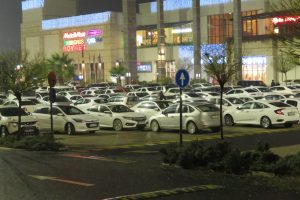
It is unusual for women to be on the street after sunset, unless accompanied by men. For safety in general: if you are not used to travel in risky, unsafe areas, do not go to Şanlıurfa on your own. There are group journeys, although not many because companies can not always deal with the risks of this region either. Be vigilant: personal safety is your main concern here, 24/7. Certainly do not go to places outside Şanlıurfa city or Göbeklitepe site without anybody knowing that you go there and without knowing who is your protection on the spot when problems occur. Generally speaking in places like Harran and Sogmatar you are unprotected unless you organize it and speak the language (Turkish or Arab).
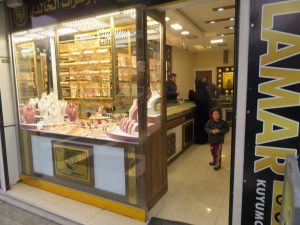

Concerning robberies and the like, you are very safe traveling in Şanlıurfa. Look at the jewellers: they all have their door widely opened to the public, during day time and even after sunset. ‘We all know each other here’, a local told me. Anyway stealing is considered as a very bad thing. If you have to pay something, you could give your wallet to the person you have to pay to – and it will be dealt with correctly. Nobody grabs your bag in the street. As a woman, I was maybe judged a lot but I was not at all harassed, not one single time. Anybody you ask help from, will help you. First of all Turcs love to help someone out, second they have a culture where everybody is used to ask little services, third you are a guest and hospitality is key, also in Şanlıurfa.

Questions
Question number one they ask you is: do you have children? This question will come to you at least ten times a day, from the hotel reception to the bakery, from the cashier at the restaurant to the woman that helps you find your way in a mosque. Not having children here means your life was useless (and that maybe you are useless, too). Either talk about your children, real or phantasy, or give ‘kismet’ = ‘fate, destiny’ as a reason for not having them, they will stop asking. Unless you like long and uneasy discussions, of course.
Question number two they ask you is: are you married? Not being married also means missing out the meaning of life. This is one of the regions in Turkey where girls are married at the age of 14 or where a position as second wife is accepted, rather than risking a life as an unmarried person. Question number three is: what is your name? Three identical questions asked all the time and in that order. The good news is: you can be prepared 🙂

Food and drinks
Food and drinks are excellent. Go to the local restaurants and eat a great meal for just a few euros. Men have their own room, usually downstairs. Some restaurants have a place upstairs for mixed groups or women and children. It took me days to find a women-friendly restaurant – in western terms. Finally, unexpectedly, in the banking district I found an open restaurant where women walked in as much as men, some of them veiled, others unveiled. It didn’t matter there and that is rare to find in Şanlıurfa. But it exists!

Alcool and drugs
There is no alcool in average public places in Şanlıurfa for religious reasons. Don’t be the troublesome tourist to push for it. This is not about your safety but your waiter´s and it’s serious. Strange enough there are drugs in Şanlıurfa, at least soft drugs and maybe more, and availability might not be difficult. One local showed me a photograph of himself in front of what I’d call a cannabis tree (!) in his own garden. Also, after sunset in darker places, there is some illegal activity. Not recommended and be careful – there is no forgiveness for foreigners.
Feel free to approach me if you will be traveling in Şanlıurfa! I enjoyed it and wish you an equally good or even better trip.








 Bilqiss is about regrets and hope for the chance to be the one you should have been. Living in a burqa is more than just having some inconvenient clothing; it is the expression of a patriarchal society where women live within the boundaries men grant them. Individual men have the right to totally suffocate the women they live with. You might be bored when I write it like this but reading Bilqiss will not bore you.
 Archaeological Museum Haarlem
 ople in that period. A woman working with the police worked on the basis of his bones to bring him ‘back to life’, for us living in the 21st century to identify with and see who made all the things that we find in excavations.
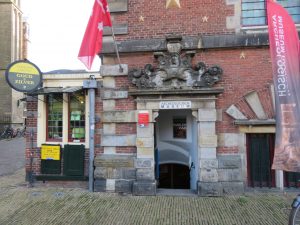 . I got all this information from a volunteer who started explaining stuff to me without asking, calmly and politely and very knowledgeable. Thanks to volunteers the Archaeological Museum Haarlem can open five times a week. It is not very big: the size of one room. Both history story lines and the objects are very well presented. Creative methods are used to get stories across and it is very child-friendly. History is in Dutch only – object names are also in English. I am sure a volunteer will be helpful for English speaking visitors. I show here some objects I particularly liked, but there are many more special pieces:


 Container to collect dripping fat:
 Battle for Haarlem:

 and an economist. Since he started writing, he won many prices: many French ones, but also this
  anish?)
 Rouiba, once the prosperous industrial suburb of Algiers, is revealed as if you walked there yourself. Le serment des barbares does not end well and that is a logical consequence of the story. When religious fanatism, anger, madness and greed reign, there is no hope.
 In English: The German Mujahid
 ’Abistan, a world that is stable and closed in itself. Religion is dominant in every aspect of daily life. To instaur the system, the past where this religion was not dominant has to be forgotten and free thought is seen as a major threat to the system. So there are many ways to check and control what people think and do. Every answer is given to the people. There is no reason for them to ask questions. However the book’s main character Ati got somehow ‘enlightened’ during a sick leave where he had time to think and to meet different people than usual. From that moment he is in constant danger.
 Simone Veil was a Holocaust survivor and she was also a major player in France’s after-war period. Une Vie tells a lot about the things she did, but her influence went much further than that because of who she was, a woman with clear principles that she followed in any function she would fulfill: ‘le sens de la justice, le respect de l’homme, la vigilance face à l’evolution de la société‘ (p. 262).
 * the letters she got when she fought as Minister of Health for the first Law on Abortion in 1975. The verbal abuse was so terrible that her staff destroyed some letters. Simone Veil regrets that because these letters are witnesses of a history of reform and should have formed study material by now to remember that changes come with pain. ‘il faut rappeler aux esprits angéliques que les réformes de société s’effectuent toujours dans la douleur‘. (p.165)
 * her ideas about human rights that she supported all her life; how militant activists rarely bring peace and rather increase human rights violations because their approach is too one-sided; that there are no universal human rights when it comes to business and other modus vivendi. ‘Au fond, ce sont toujours aux faibles que l’on fait la morale, tandis qu’on finit par blanchir les puissants‘. (p.194)
 Such a fabulous museum, the Vesunna Gallo-Roman Museum in Périgueux! A complete villa (‘domus’) has been covered and integrated into a museum together with many very interesting Gallo-Roman objects found – and with a surrounding parc that shows the beautiful and quite well preserved Vesunna Tower. To do so was not just an ambitious idea, it has effectively been realized in an impressive way.


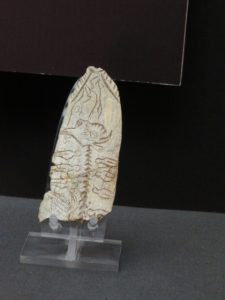 me and the prehistoric part of the museum reflects this period with very interesting findings. A dazzling collection of different stone hand axes is just the beginning. All kind of instruments useful in daily prehistoric work are presented in many shapes – and some beautiful pieces show craftmanswork like the pendant with a bison head (Magdalenien era, 15.000 BC, exact function unknown.

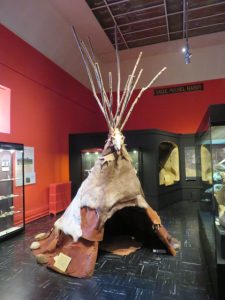
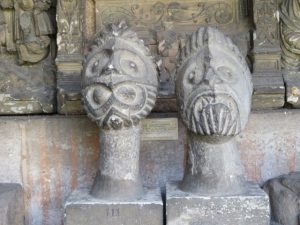 ostly mediëval stuff, I highly recommend that you take a quiet walk through the cloister just to enjoy the many details in the pieces you see there. Also the rooms with art are very nice with a great variety of interesting art objects but I am not into art myself so this blog does not describe more than just the encouragement to visit.
 benefits of the



 verview of it’s history and socio-economic life. You learn about the history of whalers, find a full whale skeleton and of course the famous little seals, see a complete
  room, kitchen and laiterie like they had in the old times; but apart from that, there are many great, even amazing artefacts that tell you maybe even more about life in Borkum. This was a museum that gave me much more than I expected when I entered. It is impossible to resume, so I show you here the artefacts that impressed me most:
 A garland made out of the hair of the deceased… Elsewhere in the museum, jewelry made out of female hairs can be found. My mouth fell open; I find it a bit spooky but here it seems to be a piece of art. One thing is sure, the results are beautiful!
 A 18th century cistern where water was collected both from the rain and from groundwater. It is big and covered with Dutch blue painted tiles who were valuable already in that era so the owner must have been very rich. The cistern kept the water cool and fresh. It is quite unique, no other cistern like this was found in the north of Germany.
 A 19th century bucket that served to collect the household money. It hang at a beam in the kitchen. That is what attracted my attention; that there were times where people hang their money in a bucket in the kitchen…. I liked the idea that it was safe there, out in the open!


 und at the beach of Borkum in 1971: a silver coin that was made in Hedel, the Netherlands which is…. the village where I was born. There is a long story to tell about coins from my native village Hedel … another time… For now: I was – happily – surprised to find this particular coin so far away from home. It proves that you will never know how far the things you make can reach, and that the extent to what it reached can be observed until centuries afterwards… so great!