

The oldest temple complex ever discovered in the world so far is Göbeklitepe in the hills of Mesopotamia. Findings date from 12.000 – 9.500 BC. Who’d ever guessed that mankind already had this type of constructions thousands of years before the pyramids of Egypt were built? That is why Göbeklitepe is called ‘zero point in time’.
Visiting Göbeklitepe was on top of my list when I traveled to Șanliurfa, south of Turkey. There is so much to discover here! A big part of the research field has not been unearthed yet. Archaeological work will extend until 20 to 30 years from now, at least. Every inch of this field contains neolitic artefacts.
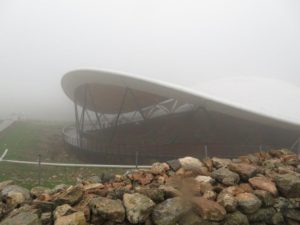
It was well-prepared that I arrived in Göbeklitepe. I read everything, I had seen many photographs. The only surprise was the weather. I travelled 6000 kilometers to find myself in terrible storm-like weather circumstances. The locals were shivering even more than I was. They stayed inside, protected from an icecold wind that brought horizontal gusts of rain soaking you whatever clothing you’d wear. What to do?
I went to the building down the hill, next to the parking place. An extra ticket of five lira gave access to a room with an audiovisual representation. Some kind of vague movie about neolitic times was shown: images ran over the walls and floor, while loud music rolled over the only spectator present. It was a dazzling experience and certainly not the most interesting part of the visit. But well, once you traveled 6000 kilometers you want to see everything to prevent missing out.

I left the building and stepped into the small bus, sponsored by the Dogus Group. Nothing about the weather had changed, so I accepted my fate. After a one, two kilometer ride to the top of the hill, the bus stopped. I saw a small museum shop but it was closed. All I could do was walk to the temples of Göbeklitepe through heavy wind and rain, so I did and arrived at a spectacular spot.
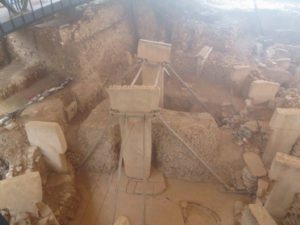
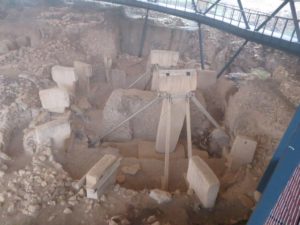
Fortunately there was a roof that stopped at least most of the rain. But the photographs I made are rather misty as the wind blew the clouds over the temples anyway. Four temples lay in front of me and it was most impressive. Especially the age, from 9.600 to 12.000 BC is unimaginable. How did neolithic humans make five meter high stèles to stand upright? Two stèles in the middle, twelve stones surrounding them.

Later, I visited the Șanliurfa Arkeoloji Müzesi where they rebuilt the largest temple found. They made it so that you can walk into the temple, an impression that makes you silent. On Göbeklitepe you look at the remains of the real temple, from above. In the museum, you experience what neolithic people have experienced when they entered the site. If you decide to make your way to Șanliurfa, I recommend that you visit both sites because it will make your experience complete.

Many animal carvations are seen on the stones, like a fox, birds, snakes. The neolithic era is considered as the time when mankind went from a hunting and nomad existence to a residential and agricultural existence. One theory says Göbeklitepe was not about religion but about domesticizing animals: people were trying to find out which animals could or couldn’t be domesticized, and that was the purpose of these buildings and the animal carvings in the rocks. It is a theory that does not explain the specific placement and number of the stones. However, we know nothing about eventual religious practices in that era so calling Göbeklitepe ‘temples’ is an uncertain theory as well. We just do not know.


An interesting stone is also this one. You see two versions: one is the on-site version and the other is the museum version that is a copy but clearer because there was no mist when I took the photograph 😊.
The idea is that the round ball is a head and – like other natural human burial/after death traditions – that the head of dead people was given to birds to be ‘cleaned’. Think of the way Persian Zoroasters dealt with dead bodies.

I loved walking around the Göbeklitepe temples, even though I almost froze. A class with school kids visited as well. Some were super concentrated when a guide explained them where they had arrived, others felt clearly miserable… The teachers looked so motivated, it was great to see. I saw groups of schoolchildren with enthusiast teachers almost on every location of heritage in Șanliurfa – so good that they invest in that! Of course a bit of nice weather helps to get the message across to the kids…

On the way back to the bus, I passed some other excavated carved stèles that apparently could not be protected yet. They were packed in wood against weather circumstances, not a superfluous measure.

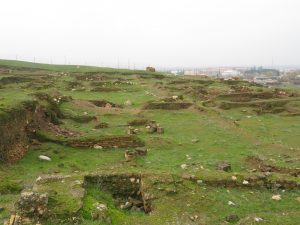
I also saw new excavation sites, one uncovered – you can see how they divide the area in helpful squares – one covered by a large roof:

I hope that roof allows them to continue the work because in the weather circumstances I passed through, that would be impossible.
–
–
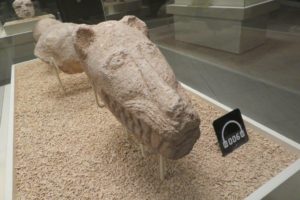
Last but not least, I like to show you some pictures of animal statues found at Göbeklitepe and exposed in the Șanliurfa Arkeoloji Müzesi. How wonderful that in a very early era, these statues were already made by humans. For me, the most attractive point of Göbeklitepe was the continuous awareness that this site and all its artefacts form a zero point in time!


You may also like: Archaeological Museum Gaziantep: ‘just’ local stuff



















 Bilqiss is about regrets and hope for the chance to be the one you should have been. Living in a burqa is more than just having some inconvenient clothing; it is the expression of a patriarchal society where women live within the boundaries men grant them. Individual men have the right to totally suffocate the women they live with. You might be bored when I write it like this but reading Bilqiss will not bore you.
 and an economist. Since he started writing, he won many prices: many French ones, but also this
  anish?)
 Rouiba, once the prosperous industrial suburb of Algiers, is revealed as if you walked there yourself. Le serment des barbares does not end well and that is a logical consequence of the story. When religious fanatism, anger, madness and greed reign, there is no hope.
 In English: The German Mujahid
 ’Abistan, a world that is stable and closed in itself. Religion is dominant in every aspect of daily life. To instaur the system, the past where this religion was not dominant has to be forgotten and free thought is seen as a major threat to the system. So there are many ways to check and control what people think and do. Every answer is given to the people. There is no reason for them to ask questions. However the book’s main character Ati got somehow ‘enlightened’ during a sick leave where he had time to think and to meet different people than usual. From that moment he is in constant danger.

 Monastery in a divided island
 And they show their power by calling the primary school of Dipkarpaz the ‘Recep Tayyip Erdogan School’ and the large square in front of the Apostolos Andreas Monastery the ‘Bülent Ecevit Square’; Ecevit was the Turkish Prime Minister in 1974 who decided to send the army into Cyprus to help the Turkish Cypriots. It is a strange pattern since over 40 years now of Greek Cypriots Always complaining as if they have no role whatsoever in what is happening, and the Turks showing muscles instead of empathy.
 the sign to remember that moment is still on the wall inside the church (see the photograph on the right). In 1974 the Island of Cyprus was divided in a Northern and Southern part. The Greek Cypriots inhabitants of the village that then was called Stylloi, went to the South while Turkish Cypriots who lived in Mouttagiaka / Mutluyaka, an old Osman village in the very South of the island, resettled in Stylloi in the North and renamed the village of Stylloi after the village they left.
 As the church of Saint Helias is quite new, there is not a lot to tell about it. The amount of concrete used is too big to call it ‘lovely’ like many other Greek churches still are. Inside, it was stripped of almost all objects, as you can see in the photograph I took.