

The 500.000 Syrian refugees form an important part of the actual population of Gaziantep. In western countries people feel that the amount of Syrian refugees form a burden: 1 million on 80 million in Germany, 60.000 on 6 million in Austria, 70.000 on 17 million in the Netherlands. They resist against the in their eyes large numbers of refugees.
Gaziantep is a town of 1,5 or 2 million people, and this town has received 500.000 (!) Syrian refugees. Think about this, compare it to the western countries I mentioned here… What is the feeling of a town where every 1 out of 4 or 5 persons is now Syrian instead of Turkish? There are several sides to this question.
Answer 1: the principle
I have found no one in Gaziantep to discuss the principle that the Syrian refugees are there for a reason and that Gaziantep should offer a shelter to them. All share that idea and find it normal to host the Syrian refugees in Gaziantep, even when it comes with a (huge) price. They see Syrians as their guests who lost everything. They see them as brothers they want to comfort in difficult times. The amount of 0,5 million refugees is seen as a heavy burden that is there to take – just like that. Already before the Syrian war, life was a struggle for the ‘ordinary’ Gaziantep-inhabitant. That life has become even more difficult. It is seen and taken as a fact of life. No one blames the Syrians for it. The Gaziantep-inhabitants have to live with it and they do. Helping Syrians is their duty and their pride. Just like that.
Answer 2: Daily practice
Syrian refugees in Gaziantep are very visible. You see them in the streets, in restaurants and coffeehouses, in the Zoo and around the shops. They do or do not work: that differs. They get loads of help in food, housing, clothing and the like. When they work, they do not pay taxes or health insurance. The Turks say: ‘your country is a mess, your house has disappeared. You are our guest. Keep your money for the day you can return – you will need it’. The ordinary, often not very wealthy Turks, pay for all the costs that the Syrian refugees bring. Moreover, they work for low wages so that ordinary Turks see their position and their income threatened. ‘Life was always difficult here, but now it has become even more difficult’, locals told me. But they do not complain, they are rather proud of the sacrifices they bring. ‘This is how we are, we want to help, look at the state of these poor refugees’.
 When Syrians drive a car in Gaziantep, they get a special numberplate. It will show M when the car was bought in Turkey, and SA when the car was imported from Syria.
  Syrians must be recognizable because they are not insured for damage done. If they cause an accident to someone else, that person has to pay for the damage. So: you drive on a road, a Syrian does not pay attention and hits your car and you have to pay for all the damage. Gaziantep-inhabitants call this ‘absurd’ but they still accept it as a fact of life. They try to avoid Syrians on the road as much as possible.
Answer 3: personal feelings
In an apparently strange contradiction to the first two answers given, I have not found anyone in Gaziantep who liked Syrians. Syrians are called ‘our guests’ and ‘our brothers’ but they are far from popular. There seems to be a consensus that Syrians have no pride and ‘no values’. They fight a lot and show no respect to each other or to the Turks.
Moreover they cause problems in the streets. Thefts have increased and shopowners explain you (softly, when nobody can hear it) that these are Syrians; they have to keep a very close eye on their business when Syrians are around. Syrians also like to go out and make a lot of noise in late hours – note that the average hard-working Turk ends the day at 22.00h. Young Syrians commit robberies, destroy public objects and make the streets of Gaziantep unsafe. I haven’t heard inhabitants blame the police because ‘so many things happen, the police can just not keep up with it’. I witnessed myself a robbery with knifes, and vandalism.
Still, no one wants to ask the Syrians to go back to Syria because there is nothing to go back to and they are our guests – in Middle Eastern hospitality you don’t ask the guests how long they will stay. It is intriguing to see that the Turks offer, even sacrify, so much to people they do not like and that that goes for them without saying.
All in all, I think the Turks and especially the people of Gaziantep deserve our deepest admiration, respect and support for their enormous contribution to the Syrian refugee crisis.
Read also: 500.000 Syrian refugees in Șanlıurfa (December 2018)
Another blog you might find interesting:
Dheepan: an outstanding movie about refugees


 Karkemish is on the border with Syria; half of the ancient city (antik kent) lies in Syria (Jarablus). I wanted to visit this but it is still closed due to the situation in Syria. Still there are active excavations and the Turkish government is preparing to reopen Karkemish as soon as possible.


 (be aware: all signs here are in Turkish only – either you can explain the animals to your children yourself or bring a dictionary) and it is fun to walk around.


 Other ‘puppets’ make clear how women and even children were filling the bullets.
 made quite explicit in several puppets. The picture here shows the underground hospital and you can see the blood run.
 Most of all however, I liked the rattles. When the French started to shoot and the Turks didn’t have enough ammunition, they would play the rattles to imitate gunfire. I got a demonstration from my guard, it was brilliant – you’d really think that a well equiped army is responding to your gunfire…

 It is nice and well enough restaured for a good impression what the castle was like in the old days.
 Lots of kids are visiting the castle to learn about the war but also many Turks from Gaziantep and elsewhere show indepth interest in the exposition.
 More on this subject:
 Also they have touchscreens where you can look up the mosaic you prefer and watch it in detail; or another touchscreen where they show you ‘land’ and you have to guess which mosaic lies under the ground. The only thing lacking is the translation of Greek texts: some mosaics show texts and you’d like to know what they say. You’d expect a museum to explain that to its visitors…
 1. The Gypsy Girl, who has somehow become the symbol of Gaziantep; she is everywhere in the streets, in shops, on the airport. They gave here a special place in a dark room where no one enters without the presence of a museum guard. And there she is, in the dark, brilliant and mysterious in the same time, uniquer than unique among all the mosaics. Indeed it is a masterpiece. While I was standing there alone in the dark, she seemed to look right through me…
 2. The Galateia mosaic, seen from above. Some mosaics have more worked out details or fuller images. I liked this one because of the balance and the colours. A description of the Galateia story can be found on the website of the museum (in English and Turkish, if you like),
  3.The out-of-the-box mosaic. I haven’t got a clue what it is but I adored it immediately. It is one of the more recent mosaics. Apparently, in that period, they started to put images in the mosaics just where they wanted – at random – no apparent rules were followed any more. I imagine that it was a breakout from all the detailed work that was done during ages; and how free it felt and how it was criticized by traditionalists and knowledgeable people and all those who feared that craftmanship was now about to disappear, to be replaced by art work that ‘even my three year old son can make’.
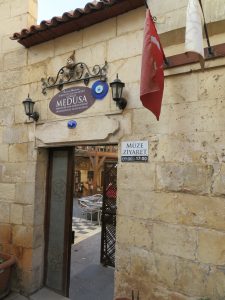 yet rather small in size and hidden in a back street.
 If you think like me, that ‘old’ starts at least in the era BC, this museum is your place to be! Some examples: they got a range of children’s toys (‘cars’) from the early bronze age (3000-2000 BC). The picture shows 2 of them. They got lots of gold from 100 BC
  (Greek). While I was watching it, I looked around full of sorrow: was this place really well protected? The Medusa Museum gives you the idea of a home, rather than a museum with full security equipment… I thought (you never know).
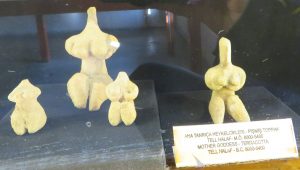 They reminded me of findings in Malta, where the same kind of mother goddess or fertility statues were found and nobody can explain what culture they belonged to, what they mean. There is a similarity with the figurines shown in the Medusa Museum which would support the theory that in ancient times certain places served religious rituals with regard to fertility and/or the female godess.
 e. To finalize: there is some amazing Roman stuff (more recent, 100-200 AC):
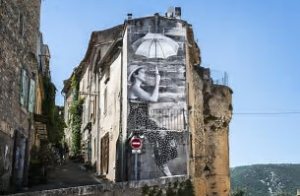
 the only inhabitant left in mine workers houses, almost forgotten by the world, becomes a monument of resistance; and so on. What is absolutely unique about this road movie that could also be called a road documentary, is the normality shown in its full brilliance. It shows that normality can be infinitely more interesting and great than the special.
 From a vivid wheelchair run through Musée du Louvre in Paris to sharing sadness and perspectives on life: it forms one breathtaking story for the spectators.
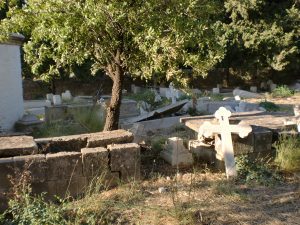 (the Turkish side), the Greek graveyards may have been destroyed deliberately as they are all in a devastating state. The situation for Turkish cemetaries in the South of Cyprus (the Greek side) is different, he says. This raises questions about why this is the case and M. Thorsten Kruse comes – roughly – to conclusions as I formulated in

