1000’s of years old boots, toys, breast pumps…


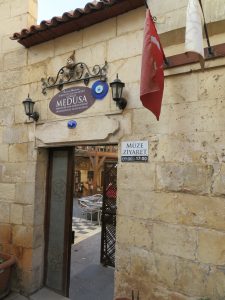
3000 years ago someone made the ‘boots’ you see here; they are rhytons, drinking vessels or horns, and date from the Urartu (read more about Urartu here). You can find them in the Medusa Glass Museum, also called the Medusa Archeological Museum in Gaziantep, Turkey. This museum is richer than most archeological museums, yet rather small in size and hidden in a back street.
If you look around in the streets close to the Kale, the castle of Gaziantep, you can find it and most people know it so just ask around; they will show you. This museum is so much worth a visit! It is most wealthy in its collection; amazing both in the amount and the quality of its artefacts. These objects would be worth a national museum with lots of space for individual pieces. More than anything this museum shows the ‘normality’ of super ancient artefacts in this region.
If you think like me, that ‘old’ starts at least in the era BC, this museum is your place to be! Some examples: they got a range of children’s toys (‘cars’) from the early bronze age (3000-2000 BC). The picture shows 2 of them. They got lots of gold from 100 BC (Greek). While I was watching it, I looked around full of sorrow: was this place really well protected? The Medusa Museum gives you the idea of a home, rather than a museum with full security equipment… I thought (you never know).

And what about this strange object that is apparently from a very old age; it is exhibited in between a marvellous Hittite stone piece and several tablets with cuneiform writing. Alas the lack of information makes you wonder without finding the answer…
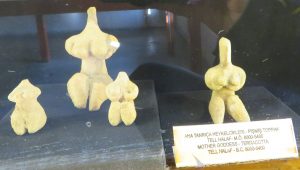
Moreover there are some figurines from 6000-5400 BC; this means among the oldest findings ever. They reminded me of findings in Malta, where the same kind of mother goddess or fertility statues were found and nobody can explain what culture they belonged to, what they mean. There is a similarity with the figurines shown in the Medusa Museum which would support the theory that in ancient times certain places served religious rituals with regard to fertility and/or the female godess.
These are just some examples. The Medusa Museum is full of comparable pieces, and glass work, stone and glass jewelry that I do not show here. To finalize: there is some amazing Roman stuff (more recent, 100-200 AC):
– ‘sexual objects’ that I do not show so you have a reason to go there.
– a breast pump (really!) made out of glass. All kind of ideas came to my mind when I watched it.
For those who love ancient times and who think `ancient` goes further back than the Middle Ages, the Medusa Glass Museum in Gaziantep is a dream – you have to go there. The title `glass museum` is misleading: there are indeed many glass objects, but even more impressive is the collection of unique non-glass pieces that deserve a full presentation (it reminded me of the Archeological Museum in Amman) – more room than there is now for them.

See also: http://www.glassismore.com

Related museums in Gaziantep:
Archaeological museum Gaziantep
Zeugma museum Gaziantep


Visages villages: brilliance of the normal


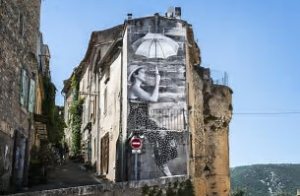
In the film Visages Villages two outstanding artists, 88 year old filmmaker Agnès Varda and 33 year old photographer JR, show the brilliance of the normal in a way that has not been done before. In JR’s van that is equiped to produce on-the-spot photo posters they cross villages and a harbour in search of people to photograph – and spots to present them on. The effect of their method is outstanding from the point of view ‘art and creativity’ and most moving for the individuals that are touched by their initiative.

The woman ‘who was just a server in the restaurant’ becomes – through her poster on the wall of a house – the most photographed woman of the village; the wives of the tough men working in the harbour are drawn out of the shadow into the light, both vulnerable and strong; the only inhabitant left in mine workers houses, almost forgotten by the world, becomes a monument of resistance; and so on. What is absolutely unique about this road movie that could also be called a road documentary, is the normality  shown in its full brilliance. It shows that normality can be infinitely more interesting and great than the special.

While creating all this, the dynamics between Agnès Varda and JR in and outside JR’s van follow their own road, interesting in itself. These people that differ so much in age find common ground in ambition, personal traits and mutual respect. From a vivid wheelchair run through Musée du Louvre in Paris to sharing sadness and perspectives on life: it forms one breathtaking story for the spectators.
Visages Villages seems to be composed out of many different elements without too much connection. Yet this film shows you life like it is and life seated still sit in your cinema chair, long after the subtitles have gone; thoughtful, amazed, and happy.

Prix Festival de Cannes: L’œil d’or pour Meilleure Film Documentaire

Trailer Visages Villageshttps://www.youtube.com/watch?v=YlQ104-3XYs

Other reviews
* https://vaguevisages.com/2017/05/20/cannes-film-festival-review-agnes-varda-and-jrs-visages-villages/
* https://www.screendaily.com/reviews/faces-places-visages-villages-cannes-review/5118156.article
* https://www.theguardian.com/film/2017/may/19/visages-villages-review-agnes-varda-jr-documentary-cannes-2017

Blogs about movies you might be interested in:
Quand on a 17 ans
Loin des hommes
Kurtulus son durak

Graveyards as symbol of ethnic conflict

graveyard as symbol
Graveyards as symbol

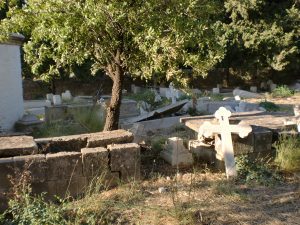
Graveyards have a role of their own in ethnic diverse regions. Remembering the dead in dignity is important, and almost symbolic when it comes to ethnic conflicts.
I have written about the bad state of the Greek-Cypriot graveyards in Northern Cyprus in 2011 and that drew the attention of M. Thorsten Kruse who works at the Institut für Interdisziplinäre Zypern-Studien at the Westfälische Wilhelms-Universität Münster. We exchanged information about the status of cemetaries in Cyprus. It is moving to see that M. Thorsten Kruse, a person with scientific ambitions has taken this heritage on as a subject.
Recently M. Thorsten Kruse has published his findings in his article “Zwischen Politik und Religion – Der Umgang mit den griechischen und muslimischen Grabstätten Zyperns nach der gewaltsamen Teilung der Insel 1974 [Between Politics and Religion – The handling of the Greek and Muslim Cemeteries in Cyprus after the Division of the Island in 1974]” in which he used photographs I made in Northern Cyprus. The article is publiced in this book: A. Berner, J.-M. Henke, A. Lichtenberger, B. Morstadt, A. Riedel (Hg.), Das Mittelmeer und der Tod – Mediterrane Mobilität und Sepulkralkultur, 2016. Please find the book at the publishing house. If you like to contact M. Thorsten Kruse directly, do so as he is willing to answer your questions!
One of the themes in his article is the fact that in the North of Cyprus graveyards as symbol(the Turkish side), the Greek graveyards may have been destroyed deliberately as they are all in a devastating state. The situation for Turkish cemetaries in the South of Cyprus (the Greek side) is different, he says. This raises questions about why this is the case and M. Thorsten Kruse comes – roughly – to conclusions as I formulated in a blog about the difference in approach of history and heritage between Greeks and Turks. The Turkish Cypriots were making up for a future in the North without the Greek Cypriots, leaving everything in the South behind with little care for Greek Cypriot heritage in the North while the Greek Cypriots were making up for a future where Turkish Cypriots will return and things will go back to the situation as it was before. This fundamental difference would lead to destruction of Greek graveyards in the North but maintenance of Turkish graveyards in the South.
I have to say here that the historic context as approached in this study mainly considers 1974 (when the Turks landed in Cyprus and took hold of the Northern part) as the turning point, while Turkish Cypriots would place that date much earlier (1963). There was destruction of Turkish Cypriot heritage in 1963. It is clear circumstances in Cyprus are very difficult to pursue a scientific study for his subject. Any choice made is not just a scientific choice but also a choice that might be seen as a cultural or political move, the expression of an opinion, a way to choose sides. This makes the job of M. Thorsten Kruse very challenging; however it is a necessary and important job. If you have ideas or funds to realize continuation, do not hesitate to contact him.graveyard symbol ethnic conflict

Read also the Alaniçi series (6 blogs), start here:
Alaniçi: churches and signs of a cruel past (1)

Kedi: movie about cats or humans?

kedi

The camera in the movie Kedi (Turkish for ‘cat’) follows many cats that walk in the streets of Istanbul/Turkey from the point of view these cats have of the city. This offers a great insight in their experiences. Overall in this movie, the camerawork is very special. Istanbul as a city and the inhabitants of Istanbul – especially the cat-loving inhabitants – are shown with warmth and beauty. Just the camerawork in itself makes the movie Kedi worth a visit.
But there is more to say. The core story shows us how cats conquer the people’s hearts. The cats choose who can love and feed them. And the people warmly respond to that wish. It is wonderful to see the different characters of the cats: from a clever thief to the psychopath of the neighbourhood, from the curious cat in the bag of organic tea at the market to the gentleman who never enters the place where he gets his food, but who simply scratches the window outside whenever he is hungry. The humans adapt to the cats; not the opposite. For cat lovers, watching Kedi is heaven!
And there is more to it. For those who love psychology and/or philosophy, Kedi has a lot to offer. People explain their relationships with the cats and come up with surprising remarks about what the cats mean for them: from finding money with the help of a cat to experiencing therapy by helping the cats. And what about these comments on the world:
– ‘cats absorb your redundant energy, just like earth does’
and:
– ‘cats know about God, dogs don’t. Dogs think that humans are God but cats know that humans are an instrument in the hand of God to feed them’.
Just two examples, there are many more.
One last thing I liked a lot and that made me think is a remark made about freedom. I have written about cats in Istanbul in 2012. The perspective that humans should not take cats inside to keep them there because in doing so, they will make cats forget how to be a cat, is new for me. This movie Kedi clearly shows what is meant with this perspective. Freedom is everything, even when it comes with disadvantages.
Maybe you don’t agree. Well, all I can say is: go see it yourself. There’s a lot more in Kedi then I can show here and you will not regret. Enjoy!

In Dutch cinemas from 24 August 2017
More info and a trailer at http://www.cinemadelicatessen.nl/film/kedi/

Other movies you may like:
Kurtulus son durak
Naziha’s spring (by Gülsah Dogan)

Travels with Herodotus

Travels with Herodotus by Ryszard Kapuscinski is an amazing book that was given to me as a second hand book by a friend already years ago. It ended up at a pile and stayed there for years. However since I travel a lot for my work in the Middle East these days, I am reading book by book through that pile while waiting at airports or flying in airplanes.
Travels with Herodotus is one of those books that I should have read earlier and that I couldn’t let go once I started reading. It is not a new book (published in Dutch in 2005 already) but who cares, nor is Herodotus who lived in the 5th century BC.
Kapuscinki proves that Herodotus has not lost any of his actuality in 2500 years for 2 main reasons:

1. He is the first known author to check and double check his stories, indicating for his readers how (im)probable the history he offers would be; that is tremendously interesting. His way of operating is amazing, checking stories in the 5th century BC cost him years but that didn’t stop him at all. He must have felt that he was not just writing for his contemporaries but for the entire humanity. So as readers in the 21st century we can follow pretty accurately the games of power of the ancient world.

2. Herodotus shows with facts the extreme cruelty of the rulers of his time – and of their advisers, family and the like. They make you think of some 20th century dictators; indeed not mankind has changed but the possibilities individuals get to apply their cruelty in daily reality. Herodotus describes the cities of Athens and Sparta as cities with a democracy where power was limited or should we say: diffuse, divided; no one was able to rule through fear and cruelty to the extent that it was found among Persians, Assyrians, Parths and many other people where the power was in the hands of one person or family. Somehow it is the system that allows humans to be cruel – or stops them. In the light of today’s debate about the value of democracy, these are intriguing thoughts.
The division of power leads to endless discussions, even on the battle field where the Greek leaders fight although the Persians are near. It is fun to read for those who have experience with democracy; nothing changed in the ‘way it is done’. And the surprise is that small Greek states without apparent unity win the war over well organized Persians who outnumber them and do not loose time in discussions about strategy. The book proves that it would have changed the course of history in Europe, had the Persians won the war. It is an encouragement to proceed on the way of checks and balances in the institution and execution of power!

Travels with Herodotus is not just about Herodotus, it is also about the author Ryszard Kapuscinski himself. He interwaves his personal story as travel journalist with Herodotus’ book Histories in an interesting and also meaningful way. I think Kapuscinski saw this book as his personal life story. On his first foreign trip that he undertook while he had always lived in closed communist Poland, Herodotus’ book accompanied him and did so on many other journeys that followed. It was not just a source of inspiration but also a method and a continuous challenge for reflection. Kapuscinski shares a lifetime outcome of that with his readers; this book has a depth that is rarely seen. It is a gift for humanity: buy it, in a second hand bookshop if no longer available, who cares.

Travels with Herodotus is a must-read for anybody who is interested in:
– (the development of) democracy versus dictatorship
– Asian and European ancient history
– travel journalism, both content/stories and methodology
– philosophy, politics, culture and anthropology.

Useful links:
https://www.theguardian.com/books/2007/jun/30/featuresreviews.guardianreview6
http://www.geschiedenis.nl/nieuws/artikel/912/reizen-met-herodotos (in Dutch)

Other blogs about books you might want to read:
‘Why are people like this?’ Boualem Sansal
Simone Veil: une vie
Dead Aid in Malawi


De jacht op mijn vader / the hunt for my father


De jacht op mijn vader: The hunt for my father is a very interesting documentary made by Gülsah Dogan. It is the second movie that I see from her and again I think her work is outstanding in many aspects.
In this documentary Gülsah Dogan follows the author Karin Amatmoekrim who is looking for her father Eric Lie in Suriname. Karin wants to write a book about her father; her mother left the country when she was still a baby and went to the Netherlands, apparently because she was not the only woman for Eric Lie. He as a famous Taekwondo champion and good looking man was popular among women. Thus Karin grew up without father far away, in the Netherlands and it is Gülsah’s quality to show the underlying feelings not by words, but in images. It is difficult not to feel some irritations during this documentary: in the title it is about the ‘hunt for her father’, however it is possible to conclude that it is more about the author herself than about the father.
The story takes place in the beautiful tropic context of Surinam and unfolds in interesting scenes and surprising pictures of the nature: from a cockridge defending itself against ants to trips on the river Marowijne.
Gülsah Dogan has produced another masterpiece after the outstanding documentary Naziha’s Spring. You can see it (in Dutch under the title De jacht op mijn vader) Thursday 11 May 2017 at 22.55h on NPO2. Let’s hope Gülsah Dogan’s work will be translated in the future because it is special what she makes.

A link describing the documentary (in Dutch):
https://www.waterkant.net/suriname/2017/05/06/documentaire-jacht-op-vader-11-mei-op-npo2/

Blogs about documentaries you might also like:
The Van Waveren Tapes
Banana pancakes and the children of the sticky rice
Taxi Teheran

Hôtel Saint-Georges: I understood…


There is a very good bookshop just outside the kashba of Tunis where I found a pearl of Algerian-French literature: Hôtel Saint-Georges by Rachid Boudjedra. There were hundreds of books in that store so what made me choose this one? (by the way maybe they were all very good). Once I started reading this book, I couldn’t let go. It is very easy to understand the many different characters, the reader will love them all and wants to read their perspective on the life they live. This desire is largely rewarded by the author.
Also Hôtel Saint-Georges gave me new insights about Algerian family relations, for example I didn’t know that it is the role of the uncle from mothers side to be tender and show love (while the uncle from fathers side only gives ‘the name’). Boudjedra pictures Algerian family dynamics in such a way that you as a reader can feel like a family member. It also gives more insights in how the cultural notion of ‘collectivism’ works. Usually when people in the West discuss collectivism that exists in countries like the Maghreb, as opposed to individualism, they think a person can not be an individual due to the family relations. Boudjedra shows that within these collectivist families, family members have strong individual lifes and characteristics. The problem as pictured in this book is rather the impossibility within a collectivist structure to discuss what goes wrong and to ‘correct’ actions of individual family members, even heavy ones that really damage others. It is intriguing to read how the FLN (an army structure to oppose the colonial regime) is used to kill a family member who had an incestuous relationship rather than confronting him and seek justice in the system. The secret remains, the punishment is sought in different ways.
A very important aspect of Hôtel Saint-Georges is Boudjedra’s choice to see actual, cruel developments as an element of history: Algerian history since the independence in 1962, French history of colonialism 1830-1962 but also ancient history, medieval history. The 90+ year old family patriarch, Sidi Mohammed, who traveled a lot and speaks many languages, gives his conclusions of a lifetime: ‘J’ai compris aussi que la barbarie est le véritable patrimoine commun de l’Humanité. J’avais fini par comprendre que le propre de l’homme, c’est la cruauté’. (‘I have understood that barbarity is the real common heritage of humanity. I have finally understood that the characteristic of mankind is cruelty‘). From this point of view, it is not an optimistic book.
And there is something else to say about this approach. In the French literature of the Maghreb, some authors long for the colonial period of the French who introduced many good things that the countries still profit from today. Faced with the actual problems of incompetence and corruption on the one side and violence and radical Islam on the other side, authors like Boualem Sansal (le Serment des Barbares) give up hope for Arab leadership and think that the French offered more. Boudjedra shows how cruel the French regime has been in Algeria; even though that did not improve after the Algerian independence, that does not mean that he feels nostalgia for the French colonial times in Algeria, on the contrary: he is rather inclined to conclude that cruelty and barbarity is part of human history, in whatever shape or nationality.
Even though it is not a happy book, it is a very beautiful book in language, in themes, in richness – it is a book that gives you a lot of food for thought. Highly recommended!

I could not find a translation of this book. Also the links I recommend are in French only:
http://www.babelmed.net/
http://www.djazairess.com/fr/infosoir/61703
http://www.lorientlitteraire.com/

Find here a recent blog about Boualem Sansal, Le serment des barbares, other books and his work as a whole
Find here a blog about Portrait du Décolonisé d’Albert Memmi
And about a great movie, filmed in Algeria, Loin des hommes


Palmpasen in Jordanië – daar waar je invloed hebt…

genderdiversiteit jordanië

Genderdiversiteit in Jordanië: vorige week gaf ik op Palmpasen (zondag = een gewone werkdag aldaar) een training over genderdiversiteit aan een team van een groot Jordaans bedrijf. ‚Zaten daar ook mannen bij‘, wordt me nogal eens gevraagd over trainingen in de Arabische wereld. Het antwoord is ja, en vaak in meerderheid. En ze staan bijna allemaal positief tegenover gender diversiteit— Nederlandse discussies als ‚waarom moet dit eigenlijk en waarom heeft dit nu prioriteit‘ worden in landen als Jordanië overgeslagen. Je gaat er gewoon aan het werk en daarmee maak je sneller meters.

Tijdens de training kwam via social media het bericht over de aanslagen op Koptische christenen in Egypte binnen. De verslagenheid was groot. De deelnemers vergeleken het meteen met een grote aanslag in Bagdad, 94 doden, aan de vooravond van een islamitisch feest en interpreteerden dat terreur juist mikt op mensen die rustig bidden en in vrede hun godsdienst willen belijden. Vanuit Nederlandse ogen lijken Egypte en Bagdad misschien ver weg van Jordanië maar de Arabische wereld heeft een sterk eenheidsgevoel. Een dergelijke aanslag komt dus keihard binnen ook al vindt die vele honderden kilometers verderop in een ander land plaats.

Veiligheid is sowieso een issue, ook in Jordanië zelf. Zo was niet alleen de locatie waar de training plaats vond zwaar beveiligd maar ook de streek eromheen omdat IS op dat moment actief rekruteerde daar. Maar zoals gezegd, niemand vroeg waarom genderdiversiteit in Jordanië nu eigenlijk moest of prioriteit kreeg, integendeel. Er heerste een sfeer waarin elk individu doet wat hij kan, want: in deze context telt elke actie. De wereld kunnen we niet veranderen maar op de inclusiviteit van onze eigen organisatie hebben we wel grip, meenden de deelnemers. En zo is het. Ze waren hartstikke gemotiveerd voor betere genderdiversiteit in Jordanië. We hebben dan ook de rest van de dag hard doorgewerkt. Hou je van diversiteit & inclusie, laat je dan niet ontmoedigen en onderneem actie op de terreinen waarop je zelf invloed hebt.

Over eerdere ervaringen met diversiteitstrainingen in Arabische landen lees je hier:
https://grethevangeffen.nl/2017/02/23/diversiteit-marokko-en-tunesie/
https://grethevangeffen.nl/2016/07/26/training-diversiteit-in-jordanie/
https://grethevangeffen.nl/2016/06/18/diversiteit-in-jordanie/

Diversiteit in Marokko en Tunesië

diversiteit inclusie marokko tunesie  Mijn ontdekkingstocht naar diversiteit & inclusie in Arabische landen gaat verder, ditmaal via diversiteit in Marokko en Tunesië. Na de start in Jordanië (Jordanië blog 2 en Jordanië blog 1) ging ik aan de slag in Tunesië en Marokko met buitengewoon spannend verlopen trainingen. Niet alleen wisselt steeds de context, zowel nationaal als qua type bedrijven, ook is het bekijken van de wereld door de bril van diversiteit & inclusie een volkomen nieuw gegeven in die landen.
Ik betreed dan ook met enige schroom de zaal waar de training plaats vindt. Gaat het programma voldoende passen in de eigen context van diversiteit in Marokko en Tunesië? Wat vinden ze ervan dat een Nederlander deze training komt geven? Hoe zal het ditmaal gaan met de taal? Want trainingen geven in het Engels en Frans betekent niet alleen voor mij werken in een tweede taal, ook de deelnemers hebben meestal een andere taal als moedertaal.
Het duurt gelukkig nog geen uur voordat we al helemaal aan elkaar gewend zijn. De inclusiviteit van de bedrijfsculturen die ik heb ervaren, helpt daar enorm bij. Diezelfde inclusiviteit leidt tot bovengemiddeld goede samenwerking als teamopdrachten moeten worden uitgevoerd.
In Tunesië maakte ik bovendien discussies mee zoals ik ze zelden hoor bij trainingen in Nederland of Duitsland: de deelnemers waren heel open in het delen van ervaringen en vlogen elkaar hier en daar flink in de haren over de vraag hoe inclusief de organisatie nou werkelijk was > op een inclusieve manier, zonder elkaar te beoordelen of zuur te worden, wat in Noordwest-Europa bij al teveel openheid in bedrijven nog weleens het risico is. Ik was diep onder de indruk en, ook niet onbelangrijk, wat hebben we gelachen. Toen ik de documentaire Danny in Arabistan – Tunesië zag – een aanrader! – herkende ik datzelfde beeld.
diversiteit inclusie marokkoIn Marokko werd ik daarbij nog verrast door de grote persoonlijke warmte van de deelnemers. Hard werken ging er gemakkelijk samen met positieve emotionaliteit, Een deelneemster gaf me na afloop haar prachtige oorbellen mee, als aandenken namens de hele groep.
Wat is het ontzettend leuk om zo samen aan diversiteit & inclusie te werken. En ja, ze mogen mijn voor trainingen diversiteit in Marokko en Tunesië zeker weer bellen!

Andere blogs over dit thema:
Seba culture and diversity workshops in Malawi
All managers are alike

Portrait du décolonisé


In 2004, 1 year before the terrible riots in the French banlieues and 7 years before the Arab spring occurred, the Jewist-Arab-French-Tunisian writer Albert Memmi writes a stunning picture about decolonized countries and the decolonized citizens, both local and emigrated, in his book Portrait du décolonisé.
Memmi describes on a factual basis the disastrous situation of many decolonized countries: the poverty, the corruption, the oppression and how these factors interlink and prevent the decolonized countries to develop and prosper. It is a sad picture that, however, can be recognized by many who worked and traveled in decolonized regions.
In 2004, the Portrait du décolonisé was not well received in France. It was criticized because Memmi wonders why the 100.000’s of deaths in several African conflicts get a lot less attention than the 3000 deaths in the Israeli-Palestinian conflict. He was accused of ‘Zionistic’ views, which would de-qualify the other 96% of his book – it must have shocked a free-thinking intellectual like Memmi who is pleading so warmly for universal values for all to live in freedom and prosperity. And the book was criticized because his portrait of the 2nd generation emigrants is one-sidedly unfavourable. He describes the migrants children that feel lost and end up in (self)destructive ideas and behaviours. It is true that the successful youth, committed to a prosperous society for all, is absent in his book – though very much existent in reality. Nevertheless what he describes has predicted many of the problems we face today in extreme forms.
His book was not translated into other languages – as far as I know – although his earlier book Portrait du colonisé was recognized by many and translated in 20 languages. Portrait du décolonisé could have supported many who wonder what happened, in the 2005 riots in the Paris banlieus, in the 2011 Arab spring, in this decade of (self)destructive terrorism.
I was speechless and breathless when I read his book, and sorry not to have discovered it earlier. Not only is it written in the beautifull, rich and touching French that Memmi masters more than hardly any other writer. He also answers many questions that arose after 2011, but he wrote this already in 2004. His language is never politically correct; he talks in clear words on every single page about the facts as he sees them. However he is never rude, never insulting people like others do who want to breach the politically correct discourse. He proves himself (again) an intellectual who dares to stand up for values and ideas, regardless the consequences.
It is difficult to understand why the world overlooked this precious contribution in a era where the need for insight in the ex-colonial world is predominant. Does this world only read the works that are either extreme or un-controversial? Does this world reject views that are confrontational just by their factional description? If you read in French, read this book. The language is superbe and it will both inform and surprise you – even if you are already knowledgeable in this matter.

Some valuable links about Portrait du décolonisé:

http://arrow.dit.ie/cgi/viewcontent.cgi?article=1002&context=jofis

http://regardscroises.blog.tdg.ch/archive/2011/02/13/portrait-du-decolonise-albert-memmi-a-lire-de-toute-urgence.html

http://journal.alternatives.ca/spip.php?article1945

Other blogs on this site about Arab-French writers:
https://grethevangeffen.nl/2018/09/29/boualem-sansal/
https://grethevangeffen.nl/2017/05/01/hotel-saint-georges/

Other blog that might interest you: Dead Aid in Malawi

Street dogs in Famagusta

street dogs famagusta

In Turkish on this picture: ‘Love means sharing. With a cup of food and water, you can fill the stomach of a street animal. Signed by the volunteers of goodness”

The way people care for cats and dogs in their streets is a sign of deeper values, I wrote in earlier blogs Street cats in Northern CyprusStreet cats in Adana and Street cats in Istanbul. In Famagusta / Gazi Magusa on Turkish Cyprus, dogs and cats are not always taken well care of but they are usually at ease. street dogs famagusta

Especially the street dogs in Famagusta are friendly, welcoming visitors and keeping them company while they climb the century old walls that the Crusaders under the rule of the Lusignan Kingdom built around old Famagusta. You’d take the lovely dog home with you immediately, if you could. People tend to warn you for the stray dogs, telling you they will bite but it is unclear where this fear comes from.
Most inhabitants of Famagusta are kind with the street dogs and cats. We just saw one incident when four Iranian students wanted to enter a restaurant where a stray dog was lying on the doorstep and one of them made a point about it. However, the personnel didn’t give any reaction to the comments made – maybe because it was in Farsi and they didn’t get the point of the problem – and the three other students convinced the fourth one to get over it; which he litterally did. This shows how great the influence of others can be, and that you can also make a difference! In general street dogs in Famagusta were given a  home, or food at restaurants: see these pictures:
street dogs in famagusta      street dogs in famagusta
Love means sharing, as the picture above tells those who pass by on different corners of Famagusta. Apparently since a short time, local governments are obliged to care for street animals. Not all of them are doing it yet, but it is a start. The friendliness of Famagusta is a good start!

Anne Frank House Amsterdam: remembrance and reflection

Anne Frank House bookcase
2000 inhabitants of Amsterdam got free tickets to visit the Anne Frank House during evening hours without queues. I was lucky to be one of them: a great initiative, thanks! It was wonderful to wander through the ‘Achterhuis’ in a quiet and respectful atmosphere.
The Anne Frank House is not far from my home and I pass the long rows of tourists a few times a week or I better say: try to pass….It is always busy, noisy, not a place where you’d like to go as an inhabitant.
I think I went there once, as a child – I remember it quite well, especially the book case (on the picture) that served as protection from the entrance to the hide-out of 8 Jewish people. These people spent 2+ years there but were betrayed at the end and only one of them, the father of Anne Frank, survived the holocaust.
anne frank house quoteCompared to my childhood visit many elements were added in the ‘museum’; quotes on walls or on blinded windows – short video’s from witnesses, classmates of Anne and the like. They are very impressive.
What I remember most are the words of Otto Frank on his daughter’s diary. He always felt close to his daughter but when he read her diary after the war, he realized that she never showed the deep thoughts and feelings that she wrote down. Since that moment he thinks that parents rarely know their children to the full. I guess that could be true. The way he expresses is very refined and respectful towards his daughter. I cannot write it down, you have to go visit the Anne Frank House and see that movie to understand the impression it made. And then imagine that he read that diary when she had already died (when she had already been killed). He would never have the opportunity to ask her any question any more…
Anne Frank House opening hoursI really thank the Anne Frank House for this opportunity. I wonder why this does not become more usual in Amsterdam. As for me, it is not about the free ticket, but the fact that I could go at 21.00h (I came home from work only at 19.30 and had to have dinner first) and that I did not need to wait in a queue or go in with plenty of loud speaking tourists. Would it be financially difficult for musea to have similar evening offers or are they just not used to opening hours in the evening?
As for the Anne Frank House tonight, it left me with quite some emotions as we live in difficult times and the idea that ‘it could happen again’ is in the hearts and minds of many. A place for remembrance and reflection, most valuable.

Other blogs that you might find interesting:
Jewish museum Warsaw
Sderot: 15 seconds to run for your life
Mikvé Israel-Immanuel synagogue: religious pearl in orange-loving Willemstad
Grandfathers, Jews and the impulse to act